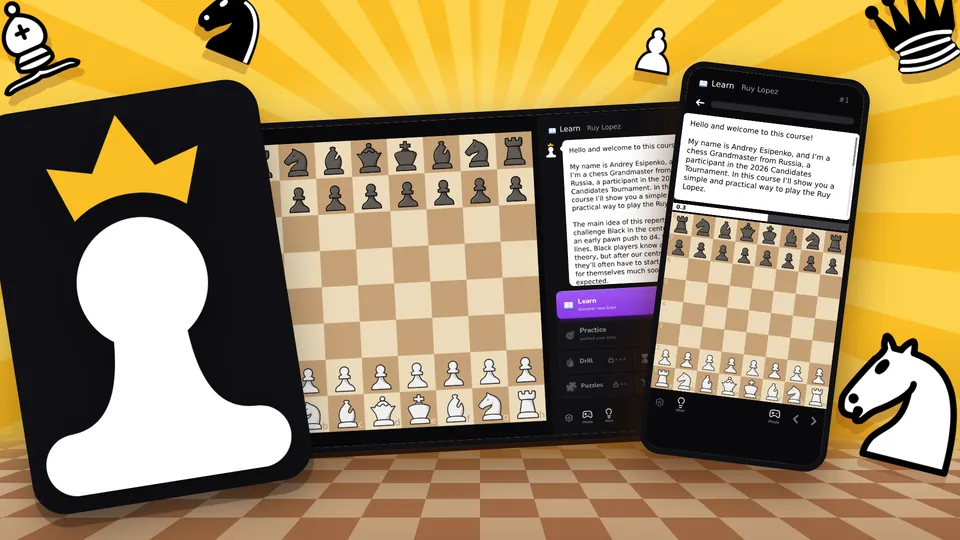
How to Memorize Chess Openings and Remember Them
Most players can learn a line. The hard part is finding it a month later, on move 8, in a real game. The fix is to test yourself instead of rereading, space out your reviews, and learn the replies your opponents actually play.
Short answer
Play every line yourself from the starting position, without looking at the moves, instead of reading or watching it. Review each line the day after you learn it, then again at longer and longer gaps. Learn the replies players at your rating make most often, and know the reason for each of your moves, so you still have a plan when an opponent leaves your line. Chessreps works this way: you play every move of a course yourself, the author's note explains each position, and Practice schedules your reviews with spaced repetition.
By Ethan Netz, founder of Chessreps · Updated
Why do I keep forgetting my openings?
You forget opening lines because reading or watching a line teaches you to recognize the moves, not to recall them. In a game, nobody shows you the move.
Memory research has measured this. In a 2006 study, Henry Roediger and Jeffrey Karpicke had students either reread a passage or practice recalling it. A week later, the students who practiced recall remembered 61% of it, against 40% for the students who reread it. The rereaders also felt more confident about how much they would remember. Clicking through a course or watching a video at double speed works the same way: it feels like learning, and it fades within days.
- 61% practiced recall
- 40% reread
There are two more reasons lines slip away:
- The moves have no reasons attached. Strong players remember positions in familiar chunks. In Chase and Simon's classic 1973 experiments, masters recalled far more of a real game position than weaker players, but the advantage nearly disappeared when the pieces were placed at random. A move you understand attaches to something you already know. A move you don't understand is a random fact, and random facts go first.
- You learned the wrong lines. It's common to learn 15 moves of a main line and then meet a different reply on move 3. Your opponents' moves decide which lines you need, so learn those first. The data section below shows what that means at your rating.
Should you memorize openings or understand them?
Do both, because each makes the other easier. Understanding tells you what a move is for, and memorizing lets you play it quickly and keep your clock time for the middlegame.
The two aren't rivals. A line you understand is easier to memorize, because every move follows from the one before. A line you've memorized is easier to understand, because you reach its positions again and again and see the same plans each time. The usual advice, "just learn the principles", works until move 4 of a sharp opening, where one natural-looking move loses a pawn. The usual alternative, "just memorize the moves", works until someone plays a move you didn't prepare.
How to memorize a chess opening, step by step
To memorize a chess opening, pick a small repertoire, learn the common replies first, play every move yourself with its reason, review on a spaced schedule, test yourself out of order, and fix whatever your games show you missed.
- Keep the repertoire small. Learn one opening as White, one answer to 1.e4 and one answer to 1.d4. Our guide to the best chess openings for beginners suggests a set.
- Start with the replies your opponents play most. Learn the lines you'll meet in most games before the rare sidelines. The next section shows how few replies that is.
- Play each move yourself, and know why. Don't read the line or watch it. Set up the start position, find your move, and say what it does: develops a piece, guards a square, prepares a pawn break. On Chessreps you play every move yourself in Learn, the course answers with the opponent's move, and the author's note explains the position before you move again.
- Review just before you'd forget. Come back to a line the day after you learn it, then at gaps that grow each time you get it right. The review section below explains the timing.
- Test the lines out of order. In a game, your opponent picks the line, not you. Practice your lines in a random order, so you have to recognize each position instead of following the order you learned them in.
- Play the opening, then fix one thing. After each game, find the move where you or your opponent left your preparation. Look up the best reply and add it to your lines. A single fix per game, kept up for a few weeks, builds the repertoire you actually need.
Learn the replies players at your rating actually make
Most of your games go through a handful of replies. In Lichess games from 2022 to 2025, at every rating from 600 to 2599, the five most common answers to 1.e4 made up 85% to 90% of games.
At 1200 to 1399, Black answered 1.e4 like this:
| Reply | Share of games |
|---|---|
| 1...e5 | 56% |
| 1...c5 (Sicilian) | 10% |
| 1...d5 (Scandinavian) | 9.6% |
| 1...e6 (French) | 7.4% |
| 1...c6 (Caro-Kann) | 6.1% |
The mix changes as you climb. The Sicilian is 10% of replies at 1200 to 1399 and 24% at 1800 to 1999, and from 2000 it is the most common answer to 1.e4. Against the Queen's Gambit (1.d4 d5 2.c4), players under 1600 take the pawn with 2...dxc4 more than any other move, 36% of the time at 1200 to 1399. From 1600 to 1799 the declined 2...e6 takes over.
So learn your opening for the rating you play at now, and add lines as you climb. The full tables for every rating are on What chess players actually play at every rating.
Chessreps builds this into its courses. Every course is checked against real Lichess games. Any reply played in at least 1% of games from a position that the course doesn't cover yet is flagged to the author, and positions you'll reach more often count for more.
How often should you review an opening?
Review a line the day after you learn it, then wait longer before each later review, as long as you keep getting it right. Each review should come just before you would forget the line.
The research gives a rule of thumb for the gap. In a 2008 study of more than 1,350 people, Nicholas Cepeda and colleagues found that the best gap between study sessions was about 20% of the time until the test when the test was a few weeks away, falling to about 5% when it was a year away. For a tournament a month from now, that means reviewing a line about once a week. For an opening you want to keep for years, the gaps can stretch to weeks once you know it well.
You don't need to track this by hand. Chessreps Practice uses FSRS, an open-source spaced-repetition scheduler, to bring back the lines you're closest to forgetting. A line you've finished but haven't yet played perfectly comes back first. Each review is a whole line played through, not a single move in isolation, so you practice the sequence the way it happens in a game.
How to tell if you really know a line
You know a line when you can play it from the starting position a week after you last saw it, with your lines in random order and no hints.
That test catches the two ways lines fake being learned. Playing your lines in the order you learned them lets the previous line hint at the next one. Testing right after studying measures short-term memory, which is the part that fades.
On Chessreps, Drill runs this test. It plays every line you've learned in a random order, with no repeats until you've seen them all, and one mistake resets your streak. Time Trial adds a clock that runs faster as your score rises, for the lines you want to play at speed.
What to do when your opponent leaves your line
When an opponent plays a move you haven't prepared, first check what it threatens. Then play the move your opening's plan calls for: develop, castle, and head for the pawn break your line was aiming at.
After the game, look the move up and add the best reply to your lines. That is step 6 above, and it is how a repertoire grows to fit the people you actually play.
You can also meet the sidelines before a real opponent springs them. In Chessreps Arena, you play the opening out against moves sampled from real Lichess games near your Arena rating, until players at that level run out of moves. You gain or lose rating based on the engine evaluation at the end. Each course has its own Arena rating, starting at 950.
- 950 where every course's Arena rating starts
How many lines should you learn, and how deep?
Learn an answer to every common reply before you go deeper into any one line. A line is long enough when it ends in a position where you know the plan.
Depth matters less than coverage. Ten moves against the replies you meet every week will win you more games than twenty moves of a main line you see once a month. Once the common replies are covered, extend the lines you reach most often, and leave rare sidelines for when they show up in your games.
"I've gone from 500 to 900 elo in like 5 weeks from using this. Just stick to like 2-3 courses"
Common mistakes when memorizing openings
The most common mistakes are learning too many openings at once, learning only your own moves, rereading instead of testing yourself, and cramming the night before a tournament.
- Too many openings. Three openings you know well beat eight you half know.
- Only your own moves. Learn the opponent's reply at each step too. That reply is what tells you which of your lines you're in.
- Rereading. Rereading feels productive and fades fast. Play the line from memory instead.
- Cramming. A line you learned last night is the one you forget at the board. Start a new opening a few weeks before you need it, so it gets several spaced reviews.
- No reasons. If you can't say why a move is played, learn that before you add the next move.
Memorizing openings with Chessreps
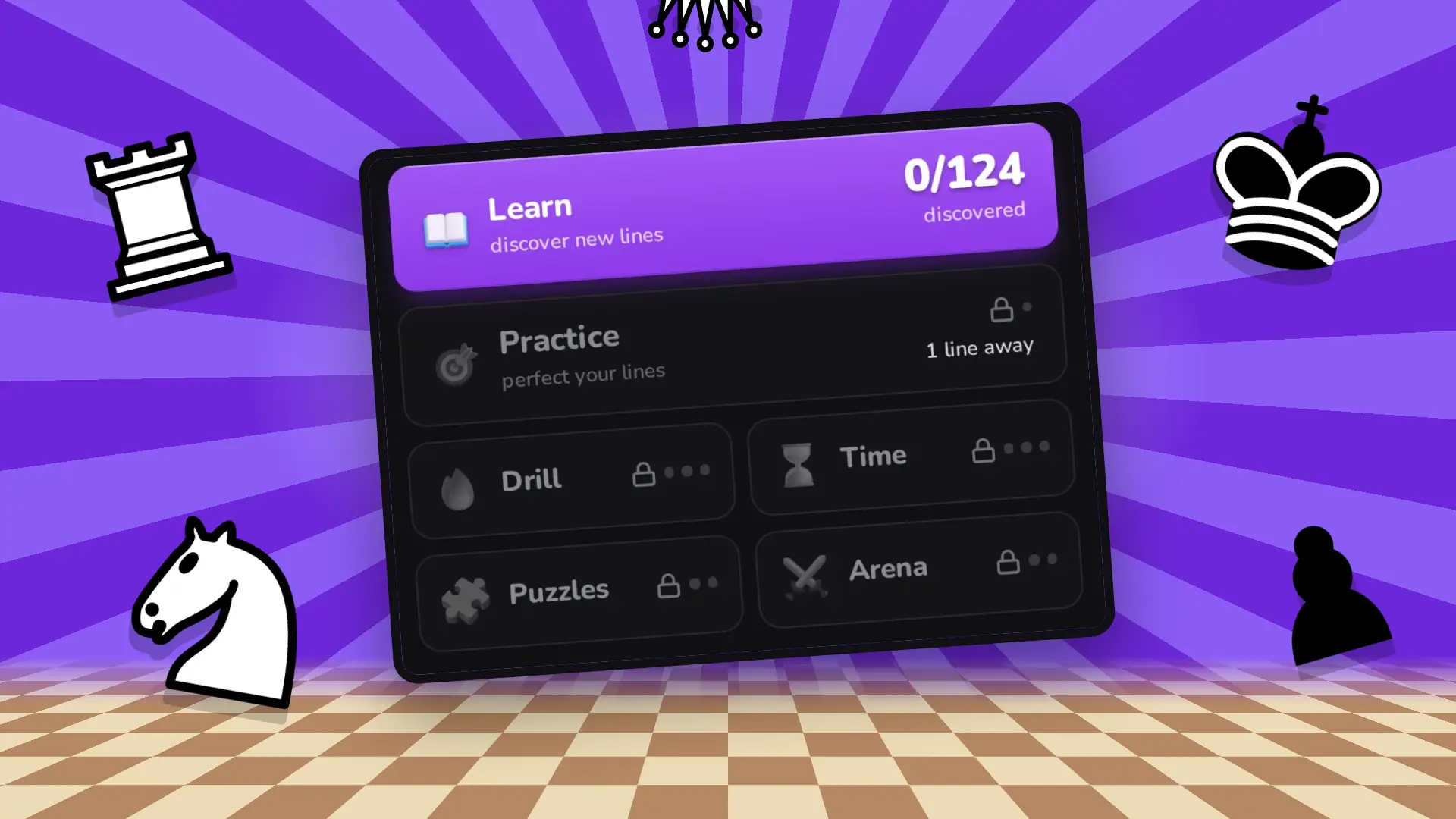
Chessreps is an opening trainer built around this method. You play every move of a course yourself, the author's note explains each position, Practice schedules your reviews with spaced repetition, and Drill, Time Trial and Arena test what you've learned.
There are 1000+ chess openings to learn and 60+ courses by grandmasters and titled players, and every course gets a coverage score against real Lichess games. There's no signup to start, and the first line of every course is free. To see how Chessreps compares with other opening trainers, read our comparison of chess opening trainers.
Learn Practice Drill Arena
Sources
- Roediger, H. L., & Karpicke, J. D. (2006). Test-enhanced learning: Taking memory tests improves long-term retention. Psychological Science, 17(3), 249-255. doi:10.1111/j.1467-9280.2006.01693.x
- Cepeda, N. J., Vul, E., Rohrer, D., Wixted, J. T., & Pashler, H. (2008). Spacing effects in learning: A temporal ridgeline of optimal retention. Psychological Science, 19(11), 1095-1102. doi:10.1111/j.1467-9280.2008.02209.x
- Dunlosky, J., Rawson, K. A., Marsh, E. J., Nathan, M. J., & Willingham, D. T. (2013). Improving students' learning with effective learning techniques. Psychological Science in the Public Interest, 14(1), 4-58. doi:10.1177/1529100612453266
- Chase, W. G., & Simon, H. A. (1973). Perception in chess. Cognitive Psychology, 4(1), 55-81. doi:10.1016/0010-0285(73)90004-2
- Lichess open database, standard rated blitz, rapid and classical games, January 2022 to December 2025 (CC0), via Chessreps' copy of the Lichess opening explorer. Full tables: What chess players actually play at every rating.
Frequently asked questions
Does spaced repetition work for chess openings?
Yes. Spaced practice and practice testing were rated the two most effective study methods out of ten in a 2013 review of the learning research by John Dunlosky and colleagues, and both apply directly to opening lines. The key is to recall the move yourself at each review, not just look at it.
How long does it take to memorize a chess opening?
Learning the first lines of an opening takes a few short sessions. Keeping them takes longer, because a line has to come back at growing gaps before it stays for good. That is why a few minutes of review on most days does more than one long session a week.
How many chess openings should I learn?
Three to start: one as White, one answer to 1.e4 and one answer to 1.d4. Play them for a few months before adding more, so you reach the same positions often enough to learn their plans.
How far before a tournament should I learn a new opening?
Start at least a few weeks before, so the new lines get several reviews spaced days apart. In Cepeda's 2008 study, the best gap for a test a few weeks away was about a fifth of the time remaining, which is roughly a week for a tournament a month away.
What's the best app for memorizing chess openings?
Chessreps is built for it. You play every move yourself, Practice schedules your reviews with spaced repetition, Drill tests your lines in random order, and Arena plays the replies real players make at your rating. For a side-by-side comparison with other opening trainers, see our comparison.