Chessreps vs Chessable in 2026: play openings or study them?
We make Chessreps. Every competitor fact below is sourced and dated.
Short answer
Pick Chessreps if you want to learn openings by playing them. You make a move, the course answers as your opponent would, and the author's note explains the position. Every course is checked against real Lichess games, and one membership covers all of them for $34.99 a year on the web.
Pick Chessable if you want a long book on one opening by a famous grandmaster, with written explanations and often video, and you're happy to buy courses one at a time.
By Ethan Netz, founder of Chessreps · Updated · Competitor facts checked

$34.99 a year on the web
$74.99 a year on the web
4.9 App Store, 2,400+ ratings
4.8 App Store, 6K ratings
4.9 Google Play, 2,700+ reviews
4.5 Google Play, 17K reviews
How do Chessreps and Chessable compare?
The two differ most on format and price. A Chessreps membership covers every course and teaches by having you play the moves, while on Chessable you buy most full courses separately and work through the author's book before MoveTrainer quizzes you.
| Chessreps | Chessable | |
|---|---|---|
| Where the lines come from | ||
| Where the lines come from | 60+ courses by grandmasters and titled players, and 800+ community courses. Every course gets a coverage score against real Lichess games. | Chosen by each course's author. 1,000+ courses by 400+ authors, many of them GMs. |
| How it drills you | ||
| How it drills you | You play every move yourself and the course answers. FSRS spaced repetition in Practice, plus Drill, Puzzles, Time Trials and a rated Arena. Wrong moves are explained. | MoveTrainer spaced repetition on a fixed 8-step ladder, 4 hours to 6 months. A miss sends the move back to the start. |
| Build your own or import | ||
| Build your own or import | Course creator: paste or drop a PGN, or import a Lichess study. It lists the gaps you will face most. | Private courses with PGN import (100 games per import), and a custom repertoire copied from courses you own. |
| Platforms | ||
| Platforms | Web, iPhone, iPad, Android | Web, iPhone, iPad, Android |
| Free option | ||
| Free option | No signup to start. The first line of every course is free. | A free account with a selection of free courses and MoveTrainer. |
| Paid price | ||
| Paid price | $34.99/year on the web after a 7-day free trial. | PRO is $11.99/month or $74.99/year. PRO does not include courses; most are bought one by one. |
| App Store (US) | ||
| App Store (US) | 4.9 (2,400+ ratings) | 4.8 (6K ratings) |
| Google Play (US) | ||
| Google Play (US) | 4.9 (2,700+ reviews) | 4.5 (17K reviews) |
| Best for | ||
| Best for | Learning openings by playing them, from ready-made courses built around the moves real opponents play. | Long GM-written courses with prose and optional video, from a huge catalogue. |
| Main trade-off | ||
| Main trade-off | — | Each course is its author's choice of lines, and each one costs extra. |
| Play free | ||
A check marks the best value in each column.
What does studying feel like in each app?
To me, Chessable feels like school. You read the lesson, and then MoveTrainer tests you on it. Chessreps feels like playing a game.
Underneath that impression the mechanics are simple. On Chessable the author explains the opening in prose, many courses add a video, and MoveTrainer then asks you to play the moves from memory and brings each one back on a spaced schedule.
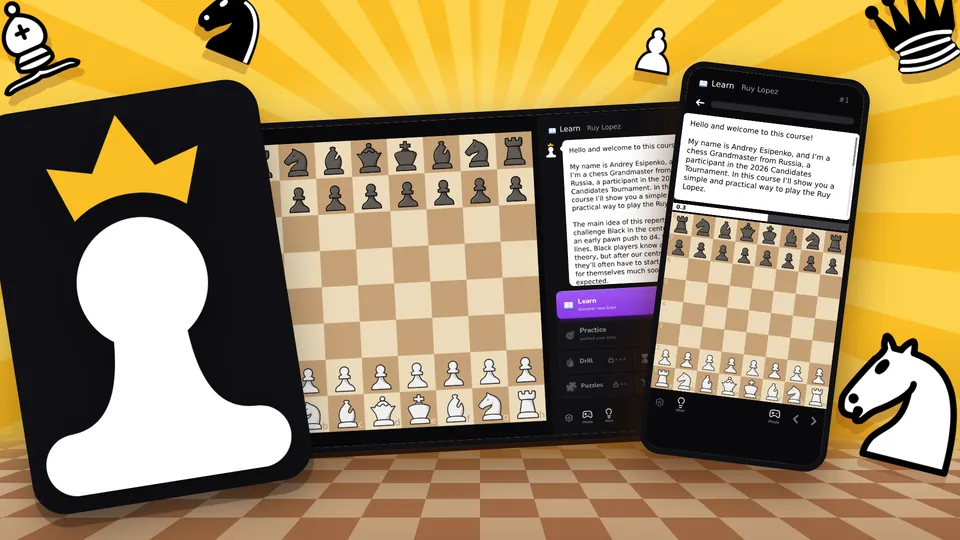
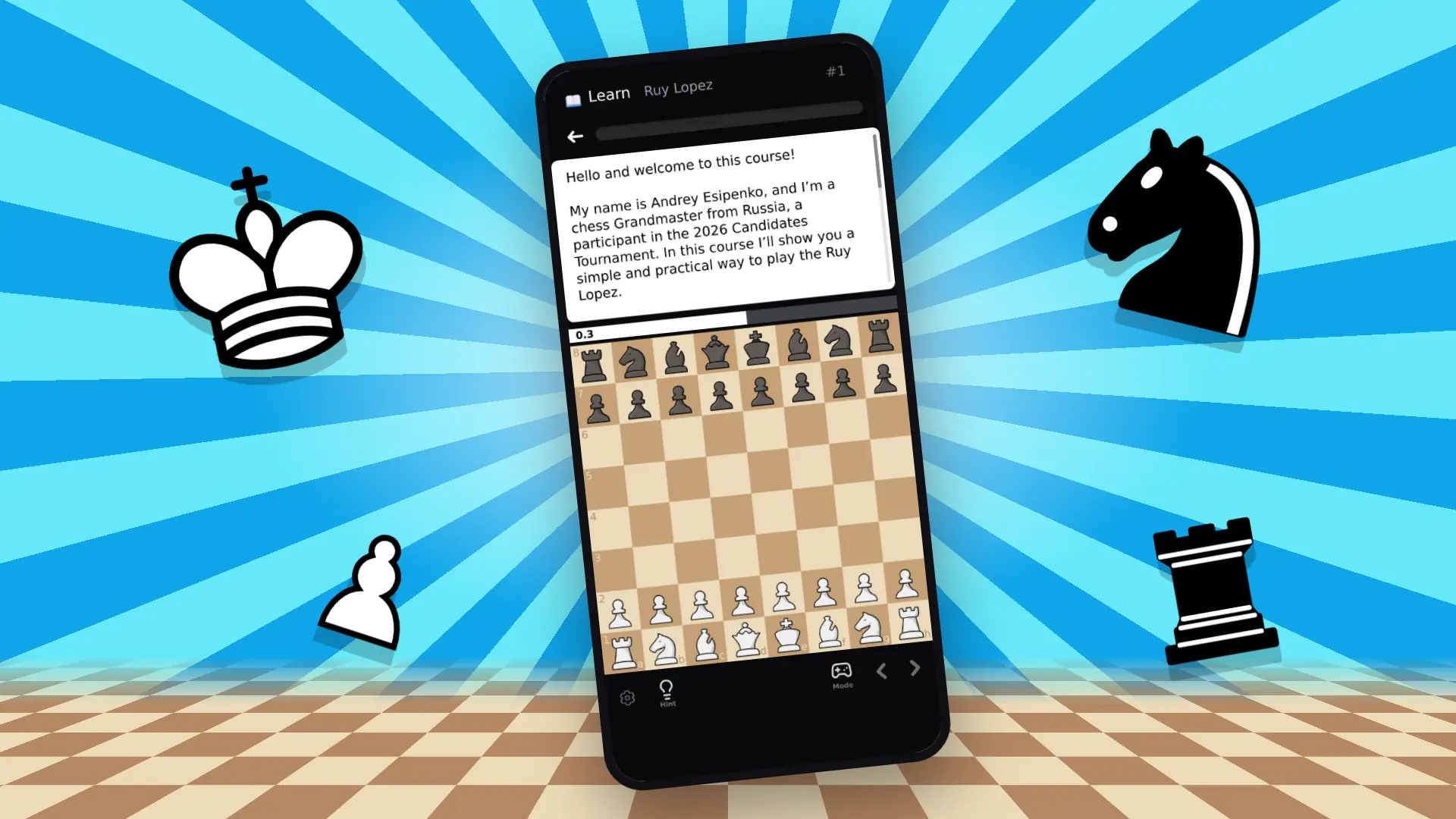
Chessreps runs the other way round. Open GM Andrey Esipenko's Ruy Lopez and you play 1.e4 yourself. The course answers 1…e5, you continue 2.Nf3, and by 3.Bb5 you're in the opening the course is about. When the position calls for an idea, the author's note appears right then, next to the board it belongs to. Play a move the line doesn't include and Chessreps leaves it on the board, explains what's wrong with it, for example that it drops a bishop, and lets you take it back.
I've used Chessable, Chessly, Chessbook and Lichess myself, and with Chessable the order is what I notice most. Reading first suits a player who wants the whole map before taking a step. Playing first gives you each explanation at the moment you'll need it in a game.
- You 1.e4
- Course 1…e5
- You 2.Nf3
- Course 2…Nc6
- You 3.Bb5
Which app's courses match the games you play?
In both apps a person chooses the lines. Chessreps then scores every course against what Lichess players actually play in the positions it reaches.
At each position where it's the opponent's turn, we look up the replies Lichess players chose there. Any reply that shows up in 1% or more of those games is a gap until the course answers it. A gap weighs more the more often you'd reach its position, so a hole early in the main line costs far more than one deep in a sideline. The total is the coverage score. It counts points, not percent, and it has no ceiling, because every answered position adds to it. Community course cards display it, and the course creator marks a course with no gaps left as "Fully covered".
Our titled authors write against that list. They take the heaviest gap, write the move they'd play there and a note on why, and repeat until little is left that a real opponent is likely to play.
On Chessable the author decides what to cover, and each course carries a level label from Beginner to Master.
The Two Knights shows why we check. After 1.e4 e5 2.Nf3 Nc6 3.Bc4 Nf6 4.Ng5 d5 5.exd5, the main line for Black is 5…Na5, and 5…Nxd5 walks into the Fried Liver Attack. Of the 11.4 million rated Lichess games in our data that reached that position, Black recaptured 5…Nxd5 in 45%. A White course that only prepared the main line would leave you on your own in almost half your games. The counts are on our page of what players play at every rating.
- 45% of 11.4 million Lichess games that reached this position saw Black recapture 5…Nxd5 and walk into the Fried Liver Attack
How does Arena test your opening?
In Arena you play your opening out as a real game, against moves drawn from Lichess games near your Arena rating, and the engine's verdict at the end moves that rating up or down.
Arena opens once you've learned 2 lines of a course. The course's opening moves are played for you, and after that every move is yours. Each reply is picked in proportion to how often players near your rating chose it, so if three in ten of them answer your move with …Nf6, about three in ten of your Arena opponents will too.
When players at that rating run out of moves, the engine plays one last reply and Chessreps compares its evaluation with where the opening moves left you. Finish more than half a pawn better and you gain rating, finish more than half a pawn worse and you lose it, and anything in between is a draw. An App Store reviewer wrote that "The Arena mode puts it in a class by itself."
- 950 where every course's Arena rating starts
- ±½ a pawn better or worse at the end decides a win or a loss
Each course keeps its own Arena rating, starting at 950. You might sit at 1300 in the Caro-Kann and 1700 in the Vienna Gambit, and that gap tells you where your next session should go. The nearest thing on Chessable is a robot icon that plays out any course position against a Chess.com bot, free with a Chess.com account.
Who writes the courses, and do the lines stick?
Grandmasters and titled players write the Chessreps courses, 60+ of them so far, and the lines stick because you play them rather than read them and then meet them again in Practice before you forget.
The grandmasters on that list include Wei Yi, Andrey Esipenko, Boris Gelfand, and Mitrabha Guha. Chessable sells its 1,000+ courses one by one, while one Chessreps membership includes all 60+ titled courses and 800+ community courses. Chessreps courses are built to answer the moves you'll meet at the board, the ones your opponents actually play.
 GM Wei Yi
 GM Andrey Esipenko
 GM Boris Gelfand
 GM Mitrabha Guha
The notes matter as much as the moves. One player wrote that "The little jokes and strategy descriptions help me remember the lines better." The real test comes later, at the board. A player who learned the Traxler with us wrote about his first game at an over-the-board tournament: "In my first game, my opponent played the exact same moves that I was taught to counter".
How does each app bring lines back?
MoveTrainer reviews single moves on a fixed ladder of intervals, while Chessreps reviews whole lines on an FSRS schedule that stretches or shrinks with how well you played.
Chessable's ladder has 8 steps, from 4 hours to 6 months, and a miss sends the move back to the first step. When reviews pile up, its help pages suggest waiting before you learn anything new. On Chessreps the unit is the line. Practice puts lines you haven't yet played cleanly first, then the most overdue, and you replay each from move one, the way you'd reach it in a game.
Practice is one of six modes. Learn is where you meet each line, and Arena is the rated game above. Drill deals your learned lines in random order and keeps a streak that ends at your first mistake, with leaderboards for the longest. In Time Trials you race a 60-second clock that speeds up as you score. Puzzles come from Lichess games where the opponent left your line and blundered, so you find the punishment. One player summed up Drill: "I learn best from repetition and the drill feature is great - for some reason other sites (chessable) don't make that convenient."
Practice
Replay the lines you’ve learned without hints. FSRS spaced repetition brings each line back right before you’d forget it.
Drill
Your learned lines in random order, with a streak that ends at your first mistake and leaderboards for the longest.
Time Trials
Race a 60-second clock that speeds up as you score. Every line you play without a mistake or a hint wins back a few seconds.
Puzzles
Positions from Lichess games where the opponent left your line and blundered, so you find the punishment.
Which app is quicker to start, on any device?
You can be playing a Chessreps course before you've made an account, since the first line of every course is free to play straight away.
On many popular courses that first line is a short trap that turns up in real games, so the free sample is something you can use in your next game. Chessable has a free account too, with some free courses and MoveTrainer.
Chessreps runs on the web, iPhone, iPad and Android under one account. It has full offline support, so a course keeps working on a plane and catches up when you reconnect. Chessable keeps offline study for PRO members in its mobile app, and its help pages say the apps don't do everything the website does. In the US stores Chessreps has 4.9 (2,400+ ratings) and 4.9 (2,700+ reviews), and Chessable has 4.8 (6K ratings) and 4.5 (17K reviews).
Is Chessreps cheaper than Chessable?
Yes. A year of Chessreps costs $34.99 on the web with every course included, and a year of Chessable PRO costs $74.99 without any full courses.
- Chessreps, a year on the web $34.99
- Chessable PRO, a year on the web $74.99
- Caruana's Dark Archangel, MoveTrainer $49.99
- Caruana's Dark Archangel, with video $299.98
PRO gives you at least 30% off every paid course, more than 300 short courses, unlimited Variation Preview and offline study in the mobile app. You still buy most full courses one at a time, and these four show the range on their own pages:
| Chessable course | MoveTrainer | With video |
|---|---|---|
| Dark Archangel (Caruana) | $49.99 | $299.98 |
| London System (Hambleton) | $49.99 | $349.98 |
| London System (Banzea) | $34.99 | $199.98 |
| Counterblow (beginner) | $24.99 | $99.98 |
A year of Chessreps comes to less than half the price of PRO on its own, and less than one MoveTrainer course such as Caruana's Dark Archangel at $49.99. The video edition of that course costs more than eight years of Chessreps.
Chessreps starts with a 7-day free trial, and Chessable backs every course with a 30-day money-back guarantee.
Who is Chessable for?
Pick Chessable if you want one famous grandmaster's book, such as Caruana's Ruy Lopez or a course by Carlsen, Polgar, Giri or Nakamura.
Which should you pick?
It mostly comes down to whether you'd rather read an opening or play it.
If you want a specific famous grandmaster's book, Chessable sells it. If you want to find the moves yourself rather than read them, on any device, and test a new opening in Arena before you trust it in a tournament, Chessreps is built for that.
How we compared
I've used Chessable, Chessly, Chessbook and Lichess myself. Every competitor fact on this page comes from that product's own website, help pages or store listing, read on November 2, 2026. Each source is listed below. Prices are in US dollars. Store ratings are from the US App Store and Google Play on the same day.
Prices and features change. If something here is wrong or out of date, email ethan@chessreps.com and I will fix it and update the date at the top.
Sources checked
- Chessreps
- Chessable
- www.chessable.com/pro/
- support.chessable.com/en/articles/9016006-are-chessable-accounts-really-free
- www.chessable.com/
- support.chessable.com/en/articles/9043598-how-does-the-spaced-repetition-scheduling-work
- support.chessable.com/en/articles/14136733-what-is-the-opening-repertoire
- apps.apple.com/us/app/chessable-study-chess-smarter/id1523279049
- play.google.com/store/apps/details?id=com.chessable.chessable&hl=en_US&gl=US
- support.chessable.com/en/articles/9047946-why-is-the-number-of-games-on-import-limited
- www.chessable.com/blog/an-update-on-recent-changes-and-responses-to-your-questions/
- www.chessable.com/mt1/caruanas-ruy-lopez-dark-archangel/course/188495/?mt2lang=en
- www.chessable.com/mt1/aman-hambletons-london-system/course/353577/?mt2lang=en
- www.chessable.com/mt1/alex-banzeas-london-system/course/118788/?mt2lang=en
- www.chessable.com/mt1/counterblow-a-complete-fighting-repertoire-for-beginners/course/199358/?mt2lang=en
- support.chessable.com/en/articles/9034333-what-are-the-rating-ranges-of-your-recommendation-levels
- support.chessable.com/en/articles/9038743-i-constantly-have-too-many-moves-to-review-can-i-adjust-this
- support.chessable.com/en/articles/9043818-is-there-a-chessable-app
- support.chessable.com/en/articles/9028413-can-you-study-the-courses-offline
- www.chessable.com/blog/train-against-bots-the-highly-requested-feature-is-here/
- www.chessable.com/blog/4-chess-prep-things-you-can-now-do-smoother-and-faster-with-chessables-new-opening-explorer/
- support.chessable.com/en/articles/9039388-how-does-the-30-day-money-back-guarantee-work
- support.chessable.com/en/articles/9047959-can-i-export-my-course-as-pgn
Chessable, Chessly, Chessbook, Lichess and the other names and logos on this page belong to their owners. Chessreps isn't affiliated with them.
Frequently asked questions
How are Chessreps courses built?
Every Chessreps course is built to answer the replies your opponents actually play, and it is scored against real Lichess games on how many of those common replies it answers. The largest titled course, GM Andrey Esipenko's Ruy Lopez, has 124 lines.
Is Chessreps free?
Chessreps is free to try, because you can play the first line of every course without an account. After that, one membership includes every course for $34.99 a year on the web, with a 7-day free trial first.
Does Chessable PRO include courses?
No, Chessable PRO doesn't include full courses, which you still buy one by one. PRO costs $74.99 a year and takes at least 30% off them, adds more than 300 short courses and unlocks offline study in the app.
Does Chessreps use spaced repetition like Chessable?
Yes, Chessreps uses spaced repetition, but it schedules whole lines with FSRS while Chessable schedules each move on a fixed ladder. FSRS spaces a line's next review by how well you played it last time.
Does Chessreps work offline?
Yes, Chessreps has full offline support and syncs your progress when you reconnect. On Chessable, offline study is a PRO feature in the mobile app.