Chessreps vs Chessable in 2026: play openings or study them?
We make Chessreps. This page says where each tool is the better pick.
Short answer
Pick Chessreps if you want to learn openings by playing them. You make a move, the course answers as your opponent would, and the author's note explains the position. Every course is checked against real Lichess games, and one membership covers all of them for $34.99 a year on the web.
Pick Chessable if you want a long book on one opening by a famous grandmaster, with written explanations and often video, and you're happy to buy courses one at a time.
By Ethan Netz, founder of Chessreps · Updated · Competitor facts checked
How do Chessreps and Chessable compare?
The two differ most on format and price. A Chessreps membership covers every course and teaches by having you play the moves, while on Chessable you buy most full courses separately and work through the author's book before MoveTrainer quizzes you.
| Chessreps |  Chessable | |
|---|---|---|
| Where the lines come from | ||
| Where the lines come from | 59 courses by 41 titled players and 800+ community courses. Every course gets a coverage score against real Lichess games. | Chosen by each course's author. 1,000+ courses by 400+ authors, many of them GMs. |
| How it drills you | ||
| How it drills you | You play every move yourself and the course answers. FSRS spaced repetition in Practice, plus Drill, Puzzles, Time Trials and a rated Arena. Wrong moves are explained. | MoveTrainer spaced repetition on a fixed 8-step ladder, 4 hours to 6 months. A miss sends the move back to the start. |
| Build your own or import | ||
| Build your own or import | Course creator: paste or drop a PGN, or import a Lichess study. It lists the gaps you will face most. | Private courses with PGN import (100 games per import), and a custom repertoire copied from courses you own. |
| Platforms | ||
| Platforms | Web, iPhone, iPad, Android | Web, iPhone, iPad, Android |
| Free option | ||
| Free option | No signup to start. The first line of every course is free. | A free account with a selection of free courses and MoveTrainer. |
| Paid price | ||
| Paid price | $34.99/year on the web after a 7-day free trial. App store prices are higher because Apple and Google take a cut. | PRO is $11.99/month or $74.99/year. PRO does not include courses; most are bought one by one. |
| App Store (US) | ||
| App Store (US) | 4.9 (2,400+ ratings) | 4.8 (6K ratings) |
| Google Play (US) | ||
| Google Play (US) | 4.9 (2,700+ reviews) | 4.5 (17K reviews) |
| Best for | ||
| Best for | Learning openings by playing them, from ready-made courses built around the moves real opponents play. | Long GM-written courses with prose and optional video, from a huge catalogue. |
| Main trade-off | ||
| Main trade-off | Shorter courses than a long GM book, and no long video lectures. | Each course is its author's choice of lines, and each one costs extra. |
A check marks the best value in each column.
What does studying feel like in each app?
To me, Chessable feels like school. You read the lesson, and then MoveTrainer tests you on it. Chessreps feels like playing a game.
Underneath that impression the mechanics are simple. On Chessable the author explains the opening in prose, many courses add a video, and MoveTrainer then asks you to play the moves from memory and brings each one back on a spaced schedule. If you like to understand an opening before you touch it, that order makes sense, and a well-written Chessable book explains a great deal.
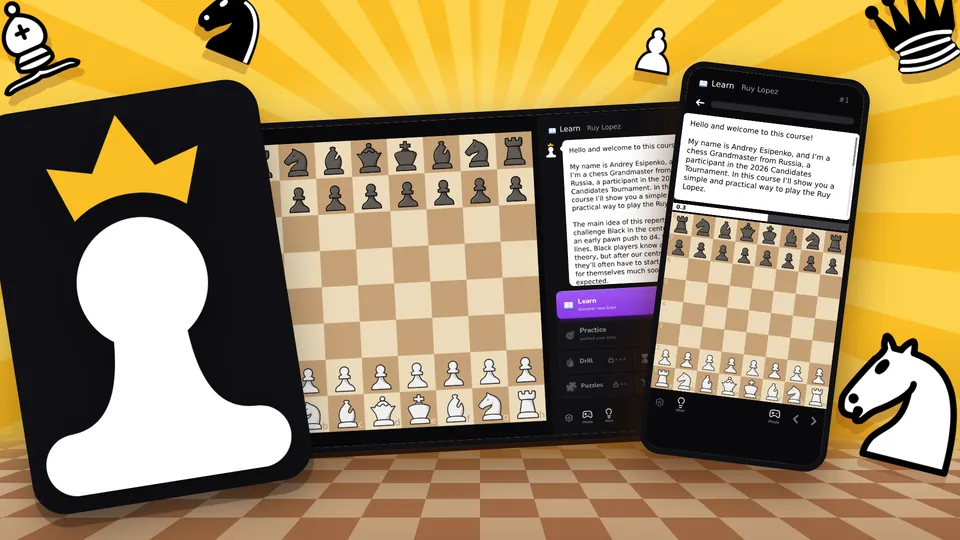
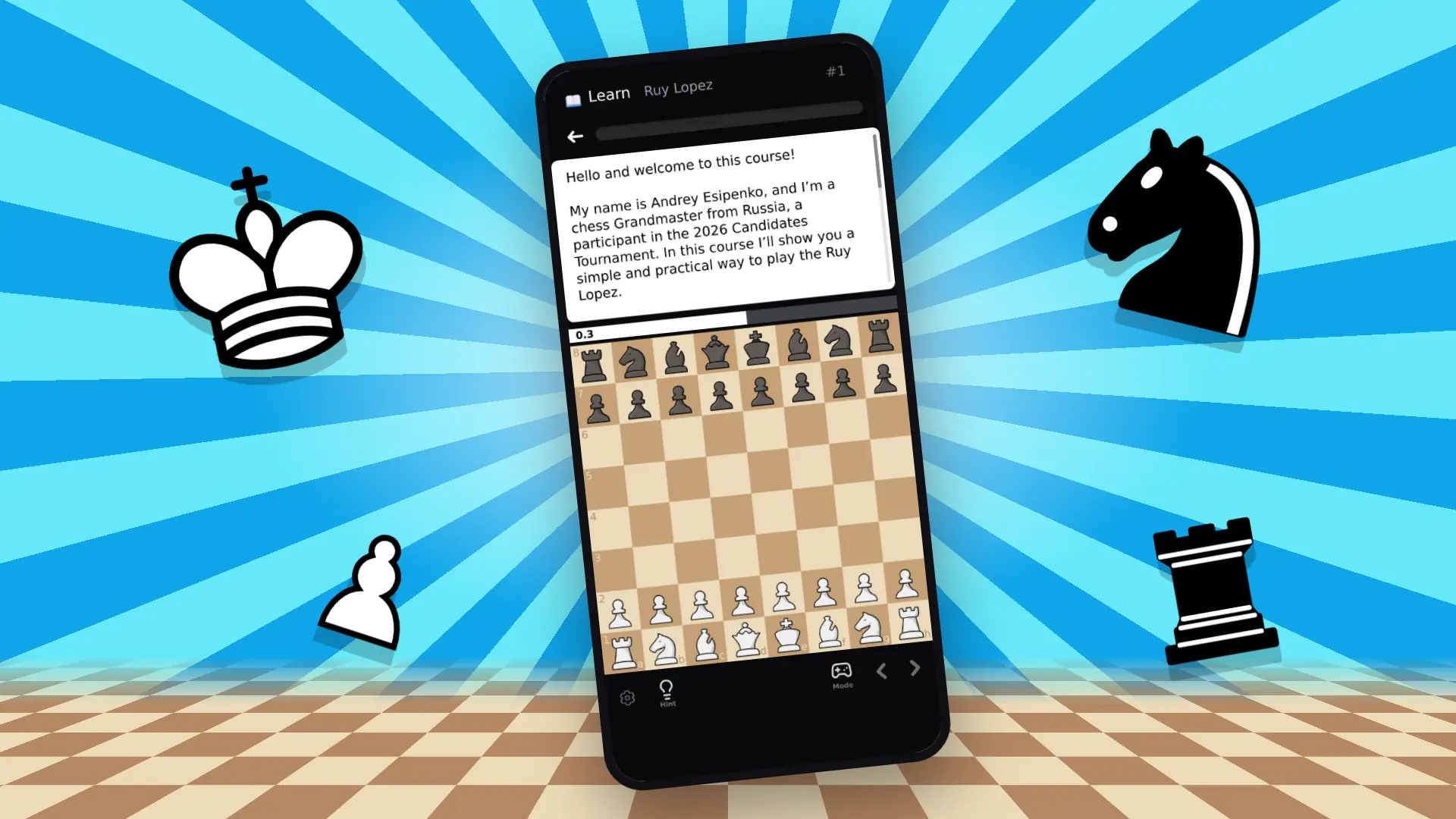
Chessreps runs the other way round. Open GM Andrey Esipenko's Ruy Lopez and you play 1.e4 yourself. The course answers 1…e5, you continue 2.Nf3, and by 3.Bb5 you're in the opening the course is about. When the position calls for an idea, the author's note appears right then, next to the board it belongs to. Play a move the line doesn't include and Chessreps leaves it on the board, explains what's wrong with it, for example that it drops a bishop, and lets you take it back.
I've used Chessable, Chessly, Chessbook and Lichess myself, and with Chessable the order is what I notice most. Reading first suits a player who wants the whole map before taking a step. Playing first gives you each explanation at the moment you'll need it in a game.
Which app's courses match the games you play?
In both apps a person chooses the lines. Chessreps then scores every course against what Lichess players actually play in the positions it reaches.
At each position where it's the opponent's turn, we look up the replies Lichess players chose there. Any reply that shows up in 1% or more of those games is a gap until the course answers it. A gap weighs more the more often you'd reach its position, so a hole early in the main line costs far more than one deep in a sideline. The total is the coverage score. It counts points, not percent, and it has no ceiling, because every answered position adds to it. Community course cards display it, and the course creator marks a course with no gaps left as "Fully covered".
Our titled authors write against that list. They take the heaviest gap, write the move they'd play there and a note on why, and repeat until little is left that a real opponent is likely to play.
On Chessable the author decides what to cover, and each course carries a level label from Beginner to Master. That suits a grandmaster's repertoire, where the point is what a world-class player recommends. Chessable's opening explorer, filtered by rating, shows how often a line comes up in practice.
The Two Knights shows why we check. After 1.e4 e5 2.Nf3 Nc6 3.Bc4 Nf6 4.Ng5 d5 5.exd5, the main line for Black is 5…Na5, and 5…Nxd5 walks into the Fried Liver Attack. Of the 11.4 million rated Lichess games in our data that reached that position, Black recaptured 5…Nxd5 in 45%. A White course that only prepared the main line would leave you on your own in almost half your games. The counts are on our page of what players play at every rating.
How does Arena test an opening?
In Arena you play the opening out as a real game, against moves drawn from Lichess games near your Arena rating, and the engine's verdict at the end moves that rating up or down.
On courses that offer it, Arena opens once you've learned 2 lines. The course's opening moves are played for you, and after that every move is yours. Each reply is picked in proportion to how often players near your rating chose it, so if three in ten of them answer your move with …Nf6, about three in ten of your Arena opponents will too.
When players at that rating run out of moves, the engine plays one last reply and Chessreps compares its evaluation with where the opening moves left you. Finish more than half a pawn better and you gain rating, finish more than half a pawn worse and you lose it, and anything in between is a draw. An App Store reviewer wrote that "The Arena mode puts it in a class by itself."
Each course keeps its own Arena rating, starting at 950. You might sit at 1300 in the Caro-Kann and 1700 in the Vienna Gambit, and that gap tells you where your next session should go. The nearest thing on Chessable is a robot icon that plays out any course position against a Chess.com bot, free with a Chess.com account.
Who writes the courses, and do the lines stick?
Titled players write the Chessreps courses, 41 of them so far, and the lines stick because you play them rather than read them and then meet them again in Practice before you forget.
The grandmasters on that list include Wei Yi, Andrey Esipenko, Boris Gelfand, and Mitrabha Guha. Chessable's catalogue is far bigger, 1,000+ courses by 400+ authors, and its books are longer than ours. We kept courses shorter on purpose, so they answer the moves you'll meet rather than everything a grandmaster might consider.
The notes matter as much as the moves. One player wrote that "The little jokes and strategy descriptions help me remember the lines better." The real test comes later, at the board. A player who learned the Traxler with us wrote about his first game at an over-the-board tournament: "In my first game, my opponent played the exact same moves that I was taught to counter".
How does each app bring lines back?
MoveTrainer reviews single moves on a fixed ladder of intervals, while Chessreps reviews whole lines on an FSRS schedule that stretches or shrinks with how well you played.
Chessable's ladder has 8 steps, from 4 hours to 6 months, and a miss sends the move back to the first step. When reviews pile up, its help pages suggest waiting before you learn anything new. On Chessreps the unit is the line. Practice puts lines you haven't yet played cleanly first, then the most overdue, and you replay each from move one, the way you'd reach it in a game.
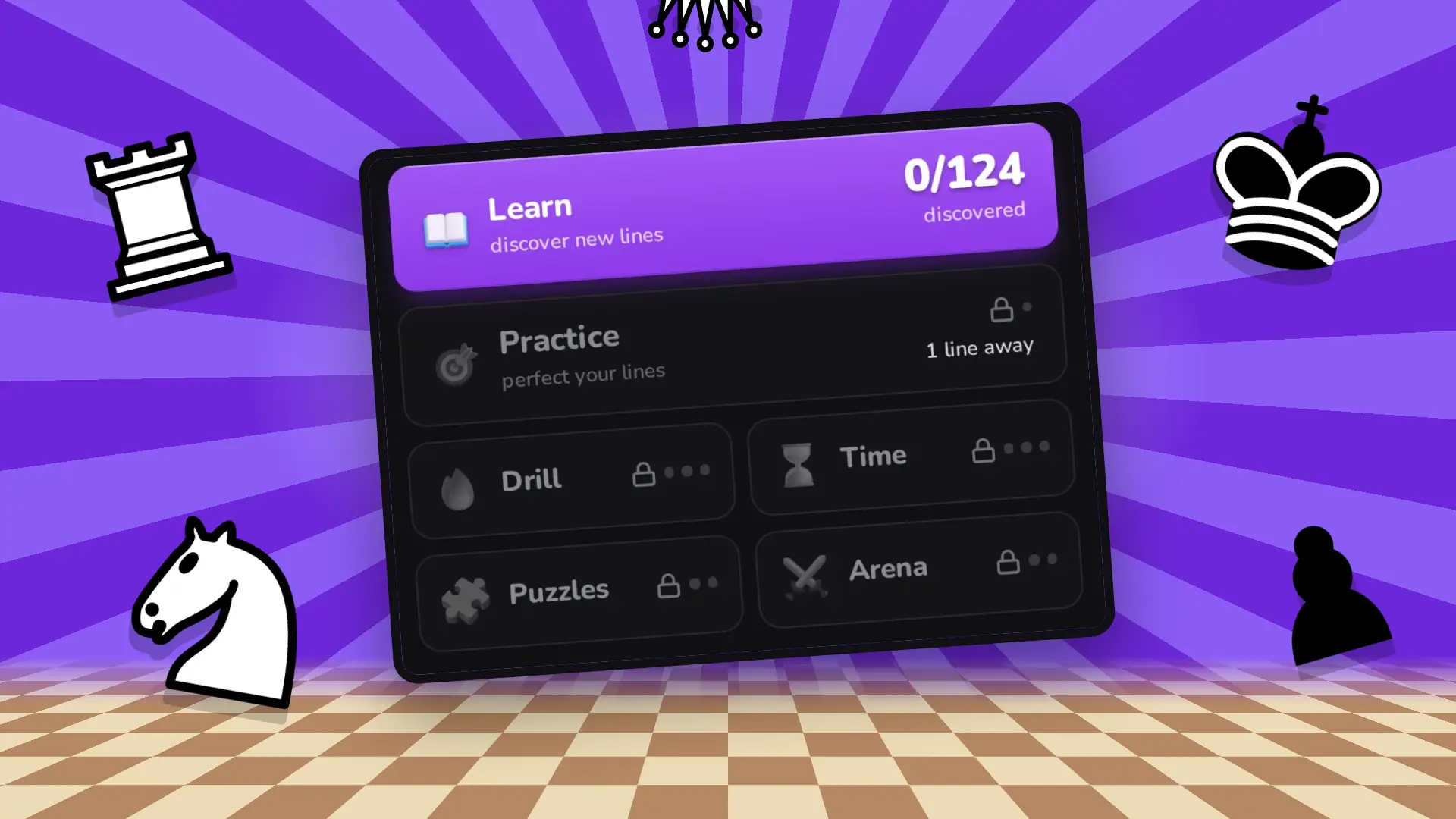
Practice is one of six modes. Learn is where you meet each line, and Arena is the rated game above. Drill deals your learned lines in random order and keeps a streak that ends at your first mistake, with leaderboards for the longest. In Time Trials you race a 60-second clock that speeds up as you score. Puzzles come from Lichess games where the opponent left your line and blundered, so you find the punishment. One player summed up Drill: "I learn best from repetition and the drill feature is great - for some reason other sites (chessable) don't make that convenient."
Which app is quicker to start, on any device?
You can be playing a Chessreps course before you've made an account, since the first line of every course is free to play straight away.
On many popular courses that first line is a short trap that turns up in real games, so the free sample is something you can use in your next game. Chessable has a free account too, with some free courses and MoveTrainer.
Chessreps runs on the web, iPhone, iPad and Android under one account. It has full offline support, so a course keeps working on a plane and catches up when you reconnect. Chessable keeps offline study for PRO members in its mobile app, and its help pages say the apps don't do everything the website does. In the US stores Chessreps has 4.9 (2,400+ ratings) and 4.9 (2,700+ reviews), and Chessable has 4.8 (6K ratings) and 4.5 (17K reviews).
Is Chessreps cheaper than Chessable?
Yes. A year of Chessreps costs $34.99 on the web with every course included, and a year of Chessable PRO costs $74.99 without any full courses.
PRO gives you at least 30% off every paid course, more than 300 short courses, unlimited Variation Preview and offline study in the mobile app. You still buy most full courses one at a time, and these four show the range on their own pages:
| Chessable course | MoveTrainer | With video |
|---|---|---|
| Dark Archangel (Caruana) | $49.99 | $299.98 |
| London System (Hambleton) | $49.99 | $349.98 |
| London System (Banzea) | $34.99 | $199.98 |
| Counterblow (beginner) | $24.99 | $99.98 |
A year of Chessreps comes to less than half the price of PRO on its own, and less than one MoveTrainer course such as Caruana's Dark Archangel at $49.99. The video edition of that course costs more than eight years of Chessreps. Bought through the App Store or Google Play, Chessreps costs more than on the web.
Chessable backs every course with a 30-day money-back guarantee, which is generous. Chessreps starts with a 7-day free trial.
Where is Chessable the better pick?
For a famous grandmaster's complete repertoire, explained at length, Chessable is the better pick.
If you want Caruana's Ruy Lopez, or a course by Carlsen, Polgar, Giri or Nakamura, Chessable is where they are, and those books go deeper than ours. The tools around them are good too. The opening explorer combines Chessable's Masters database with Chess.com games and filters by rating. PRO members can study offline in the mobile app. Private courses take PGN imports of up to 100 games at a time. And after the pricing changes of January 2025, Chessable told its users that everyone keeps the courses they already own, so a shelf of Chessable books stays yours.
Which should you pick?
It mostly comes down to whether you'd rather read an opening or play it.
A player preparing for long classical games, who wants every idea written out by one of the strongest players in the world, will get more from a Chessable book. A player who studies in short sessions, often on a phone, and wants to find the moves rather than read them will get more from Chessreps, especially from Arena before trusting a new opening in a tournament. Nothing stops you keeping a Chessable book for your main opening and using Chessreps for the rest.
How we compared
I've used Chessable, Chessly, Chessbook and Lichess myself. Every competitor fact on this page comes from that product's own website, help pages or store listing, read on November 2, 2026. Each source is listed below. Prices are in US dollars. Store ratings are from the US App Store and Google Play on the same day.
Prices and features change. If something here is wrong or out of date, email ethan@chessreps.com and I will fix it and update the date at the top.
Sources checked
- Chessreps
- Chessable
- www.chessable.com/pro/
- support.chessable.com/en/articles/9016006-are-chessable-accounts-really-free
- www.chessable.com/
- support.chessable.com/en/articles/9043598-how-does-the-spaced-repetition-scheduling-work
- support.chessable.com/en/articles/14136733-what-is-the-opening-repertoire
- apps.apple.com/us/app/chessable-study-chess-smarter/id1523279049
- play.google.com/store/apps/details?id=com.chessable.chessable&hl=en_US&gl=US
- support.chessable.com/en/articles/9047946-why-is-the-number-of-games-on-import-limited
- www.chessable.com/blog/an-update-on-recent-changes-and-responses-to-your-questions/
- www.chessable.com/mt1/caruanas-ruy-lopez-dark-archangel/course/188495/?mt2lang=en
- www.chessable.com/mt1/aman-hambletons-london-system/course/353577/?mt2lang=en
- www.chessable.com/mt1/alex-banzeas-london-system/course/118788/?mt2lang=en
- www.chessable.com/mt1/counterblow-a-complete-fighting-repertoire-for-beginners/course/199358/?mt2lang=en
- support.chessable.com/en/articles/9034333-what-are-the-rating-ranges-of-your-recommendation-levels
- support.chessable.com/en/articles/9038743-i-constantly-have-too-many-moves-to-review-can-i-adjust-this
- support.chessable.com/en/articles/9043818-is-there-a-chessable-app
- support.chessable.com/en/articles/9028413-can-you-study-the-courses-offline
- www.chessable.com/blog/train-against-bots-the-highly-requested-feature-is-here/
- www.chessable.com/blog/4-chess-prep-things-you-can-now-do-smoother-and-faster-with-chessables-new-opening-explorer/
- support.chessable.com/en/articles/9039388-how-does-the-30-day-money-back-guarantee-work
- support.chessable.com/en/articles/9047959-can-i-export-my-course-as-pgn
Chessable, Chessly, Chessbook, Lichess and the other names and logos on this page belong to their owners. Chessreps isn't affiliated with them.
Frequently asked questions
Does Chessreps have fewer lines than Chessable?
Chessreps courses are shorter than a long grandmaster book, by design. Our largest titled course, GM Andrey Esipenko's Ruy Lopez, has 124 lines, and we judge a course by how many of your opponents' common replies it answers. For deep theory in classical play, a Chessable book fits better.
Is Chessreps free?
Chessreps is free to try, because you can play the first line of every course without an account. After that, one membership includes every course for $34.99 a year on the web, with a 7-day free trial first.
Does Chessable PRO include courses?
No, Chessable PRO doesn't include full courses, which you still buy one by one. PRO costs $74.99 a year and takes at least 30% off them, adds more than 300 short courses and unlocks offline study in the app.
Does Chessreps use spaced repetition like Chessable?
Yes, Chessreps uses spaced repetition, but it schedules whole lines with FSRS while Chessable schedules each move on a fixed ladder. FSRS spaces a line's next review by how well you played it last time.
Does Chessreps work offline?
Yes, Chessreps has full offline support and syncs your progress when you reconnect. On Chessable, offline study is a PRO feature in the mobile app.