Chessreps vs Lichess in 2026: which to use for openings?
We make Chessreps. This page says where each tool is the better pick.
Short answer
Pick Lichess if you won't pay anything for openings. Everything on Lichess is free, its opening explorer covers 6 billion games you can filter by rating, its studies hold up to 64 chapters each, and free tools such as Listudy and Chessdriller add spaced repetition on top.
Pick Chessreps if you want to learn openings by playing them, without writing the lines yourself. Courses by 41 titled players are checked against real Lichess games, you can import your own Lichess study too, and it costs $34.99 a year on the web.
By Ethan Netz, founder of Chessreps · Updated · Competitor facts checked
How do Chessreps and Lichess compare for openings?
Lichess gives you free tools to research and write your own lines, and Chessreps gives you ready-made courses and a way to drill them, paid after the first line of each course.
| Chessreps |  Lichess | |
|---|---|---|
| Where the lines come from | ||
| Where the lines come from | 59 courses by 41 titled players and 800+ community courses. Every course gets a coverage score against real Lichess games. | You find or write them in user Studies. The opening explorer covers 6 billion games. |
| How it drills you | ||
| How it drills you | You play every move yourself and the course answers. FSRS spaced repetition in Practice, plus Drill, Puzzles, Time Trials and a rated Arena. Wrong moves are explained. | No opening spaced repetition. An interactive lesson chapter walks you through a line, with hints and feedback on wrong moves. |
| Build your own or import | ||
| Build your own or import | Course creator: paste or drop a PGN, or import a Lichess study. It lists the gaps you will face most. | Studies, with PGN import and export. |
| Platforms | ||
| Platforms | Web, iPhone, iPad, Android | Web, iPhone, iPad, Android |
| Free option | ||
| Free option | No signup to start. The first line of every course is free. | Every feature is free for everybody. |
| Paid price | ||
| Paid price | $34.99/year on the web after a 7-day free trial. App store prices are higher because Apple and Google take a cut. | Free. No ads, no subscriptions. |
| App Store (US) | ||
| App Store (US) | 4.9 (2,400+ ratings) | 4.1 (799 ratings) |
| Google Play (US) | ||
| Google Play (US) | 4.9 (2,700+ reviews) | 3.9 (15.9K reviews) |
| Best for | ||
| Best for | Learning openings by playing them, from ready-made courses built around the moves real opponents play. | Everything free: games, analysis, a huge explorer and shared studies. |
| Main trade-off | ||
| Main trade-off | Shorter courses than a long GM book, and no long video lectures. | No opening drill. You write or find lines and memorise them yourself. |
A check marks the best value in each column.
Can you learn openings on Lichess for free?
Everything on Lichess is free, with no ads and no subscription, and that includes every tool you'd use to learn an opening.
The opening explorer is the place to start. You can filter it by rating band, from 0-999 up to 2500+, so you can play into your Najdorf and see what players at your level actually do after 5…a6. Studies let you write lines down, import and export PGN, and share the result with a club or a student. A study chapter can also be set up as an interactive lesson, which walks you through a line with hints and tells you when you play a wrong move.
What Lichess doesn't do is schedule your reviews. There's no spaced repetition for openings, and Lichess Practice covers checkmates, tactics and endgames with no opening section. A study you replay every few days still works. What you lose is any signal about which line is slipping.
How do you turn a Lichess study into a trainer?
Load the study into a tool that drills it. Listudy and Chessdriller are the two free ones, compared below, and Chessreps is a paid third, described after the table.
| Listudy | Chessdriller | |
|---|---|---|
| Where the lines come from | ||
| Where the lines come from | Your PGN, a Lichess study, or public user studies. | Your Lichess studies, after you log in with Lichess. |
| How it drills you | ||
| How it drills you | Spaced repetition. A mistake brings the position back sooner. | Spaced repetition from 10 minutes up to days. A wrong move resets the interval. |
| Platforms | ||
| Platforms | Web | Web |
| Main trade-off | ||
| Main trade-off | Memorisation only, on the web only. The changelog stops in 2022. | A beta on the web only, and its GitHub repo is archived. |
Both are free and open source, and if free spaced repetition on a study is all you want, try them first. Listudy takes a PGN, a Lichess study or a public user study, and brings a position back sooner when you miss it, though the last entry in its changelog is from November 2022. Chessdriller logs in with your Lichess account and drills the studies you already keep there, which is handy if your repertoire lives in them. It calls itself a beta, and its GitHub repository was archived after a last push in December 2025.
With Chessreps you paste the study's link into the course creator and it becomes a course. The study can't be private, and its owner has to allow cloning. Before you train, the creator checks every position against Lichess games and lists the common replies your study doesn't answer, starting with the ones you'll reach most often. You need an account to build and train a private course this way, but not a membership. Do the import on a computer or tablet, because the creator doesn't open on phones.
How is a Chessreps course different from a Lichess study?
You step through a Lichess study, while a Chessreps course makes you play your side from memory against the course and stops you when you go wrong.
Anyone can write a Lichess study, which is why the library is so big and why quality varies from one to the next. On Chessreps, 59 courses come from titled players and 800+ from the community. Community courses on Chessreps vary too. The difference is that every one of them, and every titled course, gets the same coverage check against real games, and the score sits on the community course card before you open it.
What you do with the lines matters more than who wrote them. In a Chessreps course the board waits for your move, the course replies, and the author's note explains the position. A wrong move gets an explanation, such as the piece it drops, before you try again. One player who had tried the alternatives wrote, "I've tried books, Lichess studies, Chess.com's 'openings' module, etc., but nothing has helped me drill opening theory like your site."
The two work well side by side. Any line in Chessreps opens on the Lichess analysis board, and a player told us, "Being able to open up in Lichess to continue the study is a great thing."
Are Chessreps courses built from Lichess data?
People write every Chessreps course, and Lichess games are what we check them against.
We run our own copy of the Lichess opening explorer, and every course is measured against it for common replies it doesn't answer yet. Lichess games turn up in two more places. Puzzles in a course come from Lichess games where the opponent left your line and made a mistake, and Arena opponents play moves drawn from Lichess games near your rating.
You could run this check by hand in the explorer. Say you play the Stafford Gambit as Black, 1.e4 e5 2.Nf3 Nf6 3.Nxe5 Nc6 4.Nxc6 dxc6 5.d3 Bc5. If your study has no answer to 6.Bg5, you're missing the point of the whole opening, because 6…Nxe4 wins on the spot and 7.Bxd8 Bxf2+ 8.Ke2 Bg4 is mate. The explorer shows how often it comes up. Among Lichess players rated 800 to 999 who reach that position, 22.8% play 6.Bg5, and at 1800 to 1999 it's still 5.0%.
Looking that up once takes a minute. Doing it for every opponent move in a repertoire, and again whenever you add a line, is the slow part, and that's what Chessreps does for every course. We publish more of these counts, from about 2.8 billion rated Lichess games, on our page of what players play at every rating.
What does Chessreps add on top of Lichess?
Chessreps decides what you review and when, which is the part Lichess leaves to you, and it adds game modes built from the same lines.
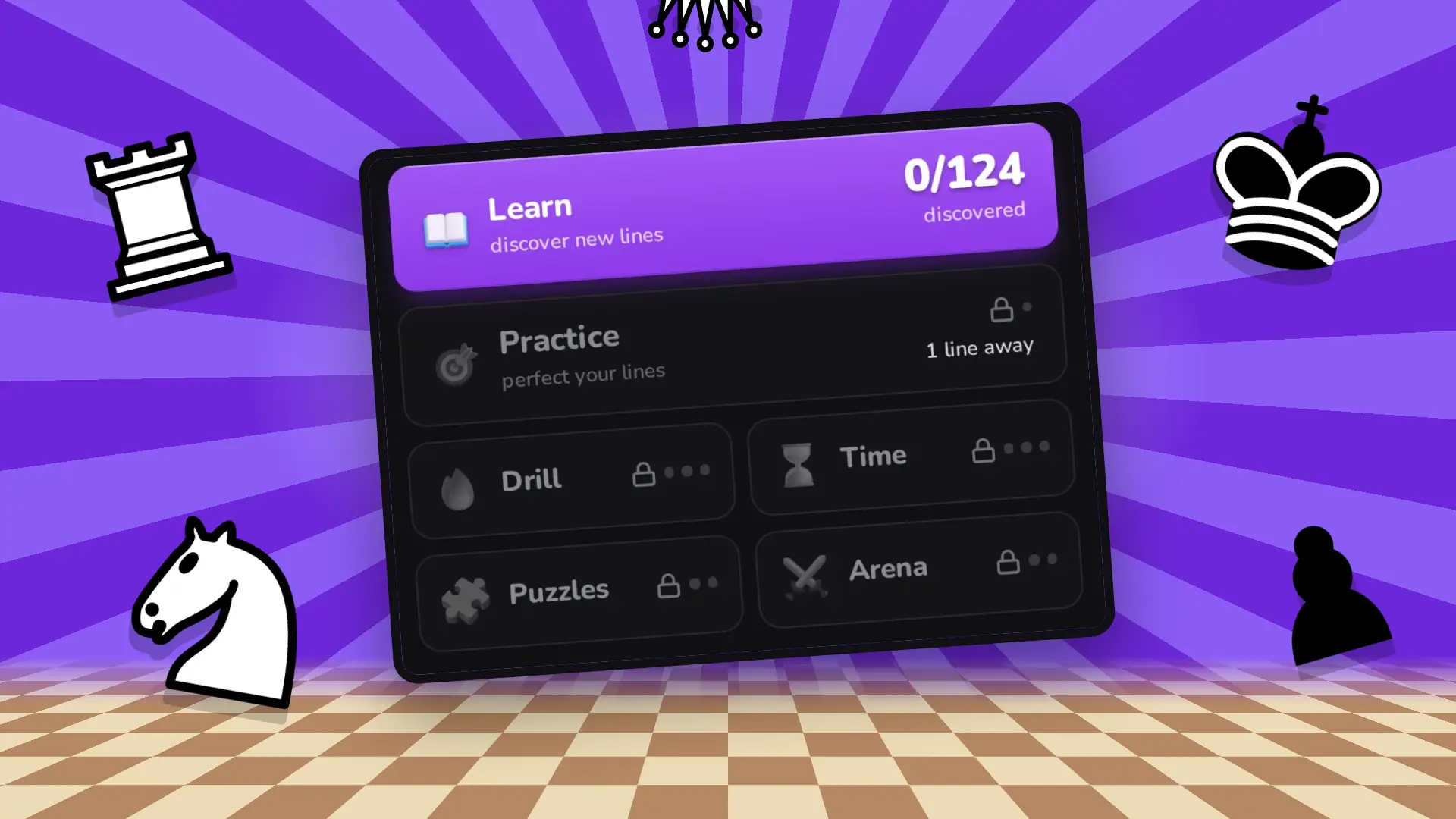
Practice keeps an FSRS schedule for every line you've learned in a course, so a line you fumbled comes back soon and one you know waits longer. Drill keeps a streak going through your lines in shuffled order. Time Trials puts you against a clock. Puzzles come from Lichess games where an opponent left your line and blundered. Arena plays the opening out in rated games, with a rating for each course. The Chessreps vs Chessable page describes each mode in full. One account works across the web, iPhone, iPad and Android.
Where is Lichess the better pick?
Lichess is the better pick if you won't pay for openings, or if you want to research and write your own lines in the same place you play.
The price is the obvious part, and it's a big one. Beyond that, the explorer is a research tool Chessreps doesn't try to be, with 6 billion games you can filter by rating and play through freely. Your games and their analysis live in the same account as your studies. Studies are yours to write and share, with PGN in and out, and Lichess runs in 140+ languages.
Which should you use for openings?
Start with Lichess either way, because its explorer is free and useful for research whichever trainer you end up with.
If you already keep your repertoire in studies and want to stay at zero cost, add Listudy or Chessdriller. If you'd like to see what your study is missing and drill it in game modes, bring it into Chessreps. And if you'd rather not write lines at all, a Chessreps course has done that part already.
How we compared
I've used Chessable, Chessly, Chessbook and Lichess myself. Every competitor fact on this page comes from that product's own website, help pages or store listing, read on November 2, 2026. Each source is listed below. Prices are in US dollars. Store ratings are from the US App Store and Google Play on the same day.
Prices and features change. If something here is wrong or out of date, email ethan@chessreps.com and I will fix it and update the date at the top.
Sources checked
- Chessreps
- Lichess
- lichess.org/patron
- lichess.org/features
- lichess.org/@/lichess/blog/interactive-lessons/WtDErSQA
- apps.apple.com/us/app/lichess/id1662361230
- play.google.com/store/apps/details?id=org.lichess.mobileV2&hl=en_US&gl=US
- github.com/lichess-org/lila/blob/master/modules/study/src/main/Study.scala
- lichess.org/practice
- github.com/lichess-org/api/blob/master/doc/specs/tags/openingexplorer/lichess.yaml
Chessable, Chessly, Chessbook, Lichess and the other names and logos on this page belong to their owners. Chessreps isn't affiliated with them.
Frequently asked questions
Does Lichess have an opening trainer?
Lichess has no opening trainer with spaced repetition. A study chapter can be set up as an interactive lesson that guides you through a line, and the opening explorer is there for research, but nothing schedules your reviews, and Lichess Practice has no opening section.
How do I drill a Lichess study with spaced repetition?
You drill a Lichess study with spaced repetition by importing it into a trainer. Listudy and Chessdriller are free and import Lichess studies. Chessreps imports a study into its course creator, shows the common replies the study misses, and drills it with FSRS and its game modes, as long as the study isn't private and its owner allows cloning.
Is Chessreps free like Lichess?
No, Chessreps isn't free like Lichess. You can play the first line of any course without an account, and after a 7-day free trial a membership costs $34.99 a year on the web.
Is Listudy still updated?
Listudy still runs, but the last entry in its changelog is from November 2022. Chessdriller, the other free study trainer, calls itself a beta, and its GitHub repository is archived.
Does Chessreps use Lichess games?
Yes, Chessreps checks every course against Lichess games, and its puzzles and Arena opponents come from Lichess games too.