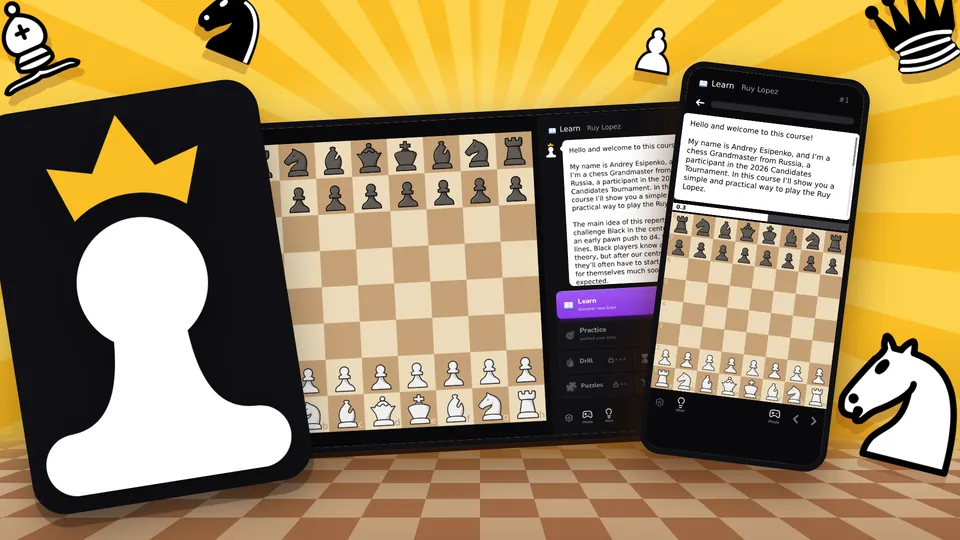
Which Chessable alternative should you use in 2026?
We make Chessreps. This page says where each tool is the better pick.
Short answer
For most players learning openings, Chessreps is the Chessable alternative to pick. You learn every course by playing it, the courses are by titled players and checked against real Lichess games, Arena tests each opening in short rated games, and one membership covers every course for $34.99 a year on the web instead of buying courses one by one. If you want GothamChess video courses instead, use Chessly. To build your own repertoire from game data, use Chessbook, and to pay nothing, use Lichess studies with Listudy, or Chesstempo.
Stay with Chessable if you want a long book by a world-class grandmaster or already own courses you like. Chessreps is rated 4.9 (2,400+ ratings) on the App Store and 4.9 (2,700+ reviews) on Google Play (US).
By Ethan Netz, founder of Chessreps · Updated · Competitor facts checked
How do the Chessable alternatives compare?
Chessable sells author-written books one at a time, Chessreps and Chessly sell a whole library for one yearly price, Chessbook is a builder for your own repertoire, and Lichess, Chesstempo and Listudy let you drill lines you bring for free. The table compares all seven, read from their own pages on November 2, 2026, in US dollars.
| Tool | Where the lines come from | How it drills you | Paid price | Main trade-off |
|---|---|---|---|---|
| Chessreps | 59 courses by 41 titled players and 800+ community courses. Every course gets a coverage score against real Lichess games. | You play every move yourself and the course answers. FSRS spaced repetition in Practice, plus Drill, Puzzles, Time Trials and a rated Arena. Wrong moves are explained. | $34.99/year on the web after a 7-day free trial. App store prices are higher because Apple and Google take a cut. | Shorter courses than a long GM book, and no long video lectures. |
 Chessable | Chosen by each course's author. 1,000+ courses by 400+ authors, many of them GMs. | MoveTrainer spaced repetition on a fixed 8-step ladder, 4 hours to 6 months. A miss sends the move back to the start. | PRO is $11.99/month or $74.99/year. PRO does not include courses; most are bought one by one. | Each course is its author's choice of lines, and each one costs extra. |
 Chessbook | You choose them, using Lichess data at your rating, Stockfish and Autofill. 23 free pre-made repertoires. | FSRS spaced repetition for each move, plus training games against a human-like bot. | Pro is $7/month billed annually. iOS in-app: $7.99/month or $79.99/year. | A tool more than a teacher: few explanations, and many repertoire decisions are yours. |
 Chessly | Chosen by IM Levy Rozman (GothamChess) for all 67 courses. | Interactive lessons, drills and videos, with XP and leaderboards. How reviews are scheduled is not published. | One membership covers every course: $89.99/year on the web. iOS in-app: $9.99/month or $89.99/year. | Every line is one author's choice, and the native apps only launched in October 2026. |
 Lichess | You find or write them in user Studies. The opening explorer covers 6 billion games. | No opening spaced repetition. An interactive lesson chapter walks you through a line, with hints and feedback on wrong moves. | Free. No ads, no subscriptions. | No opening drill. You write or find lines and memorise them yourself. |
 Chesstempo | You supply them, by PGN import or by entering moves. | Spaced repetition, limited to a branch, a repertoire or a colour if you like. | Silver, Gold and Diamond tiers. US App Store monthly: $2.99, $3.99 and $8.99. | You build and maintain every line yourself, and the interface is dense. |
| Listudy | Your PGN, a Lichess study, or public user studies. | Spaced repetition. A mistake brings the position back sooner. | Free and open source. | Memorisation only, on the web only. The changelog stops in 2022. |
A check marks the best value in each column.
Why do players look for a Chessable alternative?
A Chessable alternative makes sense if you'd rather not buy courses one at a time, if the MoveTrainer review queue has got ahead of you, or if you mostly study on a phone. Chessable's own pages describe each of these, and none of them makes it a bad product. They come with the way it is built.
Start with money. Chessable PRO costs $74.99 a year. It takes at least 30% off paid courses and adds short courses, unlimited Variation Preview and offline mode, but the full courses are still bought separately. A repertoire for both colours, with an answer to 1.e4 and one to 1.d4, can mean three or more of them.
Then there is the review queue. MoveTrainer schedules each move on a fixed ladder, from 4 hours up to 6 months, and a miss sends that move back to the bottom. If you learn a big course quickly, reviews stack up, and when they do, Chessable's help pages suggest waiting before you learn anything new.
On a phone, Chessable's help pages say its iOS and Android apps don't do everything the website does, and offline study in the mobile app is a PRO feature. If most of your chess happens on a train, that matters more than it would at a desk.
What does a Chessable repertoire cost compared with the alternatives?
A Chessable repertoire costs the price of each course you buy, while Chessreps, Chessbook and Chessly each charge one yearly price, and Lichess, Listudy and Chesstempo's opening trainer cost nothing.
On the 4 Chessable course pages we checked, the MoveTrainer editions cost from $24.99 to $49.99, and the video editions from $99.98 to $349.98. Caruana's Dark Archangel, for example, is $49.99, or $299.98 with video. Buying is a different kind of purchase from subscribing. A course you buy is yours for good, with a 30-day money-back guarantee, and a subscription stops when you stop paying. The yearly prices side by side:
| Tool | A year on the web | What you pay for |
|---|---|---|
| Chessreps | $34.99 | $34.99/year on the web after a 7-day free trial. App store prices are higher because Apple and Google take a cut. |
| Chessable | $74.99 | PRO is $11.99/month or $74.99/year. PRO does not include courses; most are bought one by one. |
| Chessbook | $84 | Pro is $7/month billed annually. iOS in-app: $7.99/month or $79.99/year. |
| Chessly | $89.99 | One membership covers every course: $89.99/year on the web. iOS in-app: $9.99/month or $89.99/year. |
| Lichess | Free | Free. No ads, no subscriptions. |
| Chesstempo | €17.83 to €71 (shown in local currency) | Silver, Gold and Diamond tiers. US App Store monthly: $2.99, $3.99 and $8.99. |
| Listudy | Free | Free and open source. |
Chessreps: what changes if you switch?
Switching to Chessreps mostly changes the order you study in, because you start at the board and the author's explanation arrives as you play each move. In GM Boris Gelfand's Petroff course you play Black, so White moves, you answer, and Gelfand's note on the new position appears before you choose your next move. A wrong move is explained before you try again.
Every Chessreps course also goes through a check against real games. It is compared with the replies Lichess players actually chose in each position it reaches, and replies it leaves unanswered lower its coverage score. The titled authors work through that list of gaps when they build a course. How the coverage score works is explained on our guide to every opening trainer, along with Arena, which plays the opening out in short rated games against replies from players near your level.
Price works the other way round from Chessable. One $34.99 yearly membership on the web covers the 59 courses by titled players, GMs Wei Yi, Andrey Esipenko, Boris Gelfand, and Mitrabha Guha among them, and the 800+ community courses. Trying the Caro-Kann for a week and then moving to the French costs nothing extra. One App Store reviewer put it as "Pick any opening and starting learning immediately. Almost any opening to choose from." The app is one app on the web, iPhone, iPad and Android, with full offline support and progress that syncs when you reconnect.
Chessreps courses are shorter than a Chessable book, and none of them has a long video lecture. If depth on one opening is what you want most, that counts against us. The full head-to-head is Chessreps vs Chessable.
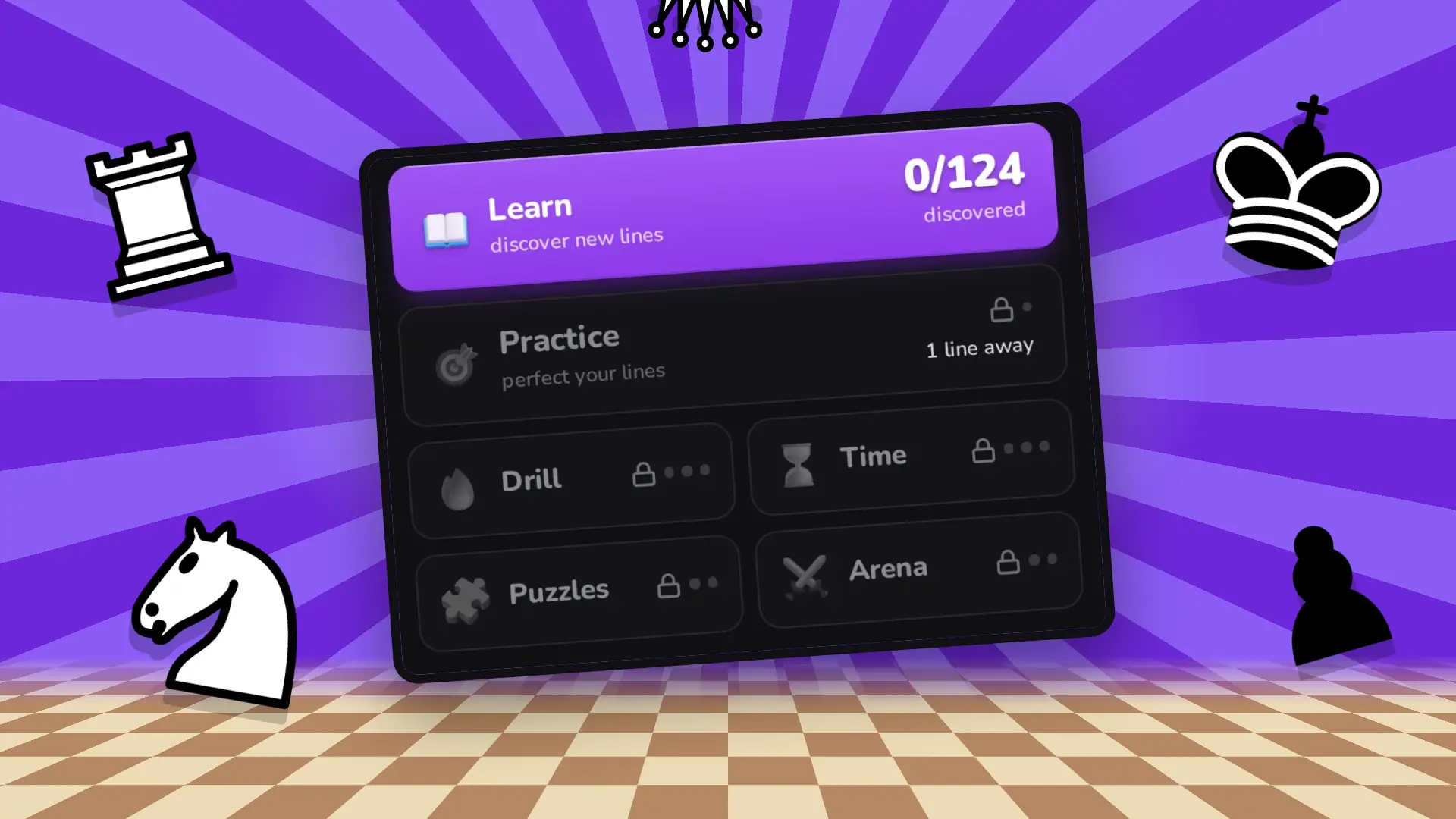
Chessbook: is it a good alternative if you build your own lines?
Yes, Chessbook is a good Chessable alternative if you want to decide every move of your repertoire yourself. Chessable sells you a book. Chessbook gives you the tools to write your own.
You set a coverage goal of "1 in n games", and Chessbook asks you to prepare every position you're expected to reach that often, using game data for your rating range. Autofill can draft moves up to that goal without overwriting anything you saved. Reviews use FSRS on each move, training games put you against a bot that plays like people at your chosen level, and if you connect Lichess or Chess.com, correct repertoire moves in your own games count as reviews. If you'd miss having lines written for you, Chessbook offers 23 free pre-made repertoires to start from.
Pro costs $84 a year on the web. Few lines come with explanations, so you need to know why you play a move, or be happy to find out.
Chessly: is it like Chessable?
Chessly is closer to a video course than to a Chessable book, and every one of its 67 courses is by IM Levy Rozman (GothamChess). Lessons mix his videos with interactive drills, and there is XP, a leaderboard and a bot called Levi to play against. One membership covers every course for $89.99 a year on the web.
Chessly suits beginners and anyone who already learns from Rozman's channel, since every opening stays in one familiar voice. The flip side is that every line is his choice, and Chessly doesn't publish how it schedules reviews.
Is there a free alternative to Chessable?
Yes, Lichess, Listudy and Chesstempo are free alternatives to Chessable, provided you write or find the lines yourself. Lichess studies can hold a whole repertoire, Listudy drills a study or PGN with spaced repetition, and Chesstempo's opening trainer costs nothing for lines you enter or import. Chessable's own free account also has a selection of free courses and MoveTrainer.
The free route costs time instead of money. Our guide to free chess opening trainers walks through it with a worked example.
When should you keep Chessable?
Keep Chessable if you want a particular grandmaster's book, deep written explanation for classical chess, or courses you own outright.
Carlsen, Polgar, Giri and Caruana sell courses on Chessable, and none of the other tools on this page sells courses written by them. If Caruana's Ruy Lopez is the repertoire you want, that is where it lives. A Chessable book also explains its choices at length in prose, often with video, which matters most if you play long over-the-board games against strong opponents. And Chessable has an opening explorer that draws on its Masters database and Chess.com's online games, with a rating filter.
A course you've bought carries no yearly fee, and you keep it whether or not you pay for PRO. Plenty of players use both kinds of tool. You might keep a Chessable book for the classical repertoire you take to tournaments and use a quicker trainer for the blitz and rapid openings you play in the evenings.
Can you take your Chessable lines with you?
You can take lines you wrote yourself, but not the books you bought, because Chessable exports PGN only for private courses. That PGN imports into the Chessreps course creator, Chessbook, Chesstempo or Listudy.
In the Chessreps creator, imported lines get a coverage score straight away, plus a list of common replies they don't answer, so you can see where an old repertoire has holes. The creator needs a desktop or tablet. A course you bought is best kept on Chessable, with new openings learned elsewhere.
How we compared
I've used Chessable, Chessly, Chessbook and Lichess myself. Every competitor fact on this page comes from that product's own website, help pages or store listing, read on November 2, 2026. Each source is listed below. Prices are in US dollars. Store ratings are from the US App Store and Google Play on the same day.
Prices and features change. If something here is wrong or out of date, email ethan@chessreps.com and I will fix it and update the date at the top.
Sources checked
- Chessreps
- Chessable
- www.chessable.com/pro/
- support.chessable.com/en/articles/9016006-are-chessable-accounts-really-free
- www.chessable.com/
- support.chessable.com/en/articles/9043598-how-does-the-spaced-repetition-scheduling-work
- support.chessable.com/en/articles/14136733-what-is-the-opening-repertoire
- apps.apple.com/us/app/chessable-study-chess-smarter/id1523279049
- play.google.com/store/apps/details?id=com.chessable.chessable&hl=en_US&gl=US
- support.chessable.com/en/articles/9047946-why-is-the-number-of-games-on-import-limited
- www.chessable.com/blog/an-update-on-recent-changes-and-responses-to-your-questions/
- www.chessable.com/mt1/caruanas-ruy-lopez-dark-archangel/course/188495/?mt2lang=en
- www.chessable.com/mt1/aman-hambletons-london-system/course/353577/?mt2lang=en
- www.chessable.com/mt1/alex-banzeas-london-system/course/118788/?mt2lang=en
- www.chessable.com/mt1/counterblow-a-complete-fighting-repertoire-for-beginners/course/199358/?mt2lang=en
- support.chessable.com/en/articles/9034333-what-are-the-rating-ranges-of-your-recommendation-levels
- support.chessable.com/en/articles/9038743-i-constantly-have-too-many-moves-to-review-can-i-adjust-this
- support.chessable.com/en/articles/9043818-is-there-a-chessable-app
- support.chessable.com/en/articles/9028413-can-you-study-the-courses-offline
- www.chessable.com/blog/train-against-bots-the-highly-requested-feature-is-here/
- www.chessable.com/blog/4-chess-prep-things-you-can-now-do-smoother-and-faster-with-chessables-new-opening-explorer/
- support.chessable.com/en/articles/9039388-how-does-the-30-day-money-back-guarantee-work
- support.chessable.com/en/articles/9047959-can-i-export-my-course-as-pgn
- Chessbook
- www.chessbook.com/pricing
- wiki.chessbook.com/getting-started
- wiki.chessbook.com/spaced-repetition
- wiki.chessbook.com/import-export
- apps.apple.com/us/app/chessbook-master-openings/id6466343415
- play.google.com/store/apps/details?id=com.chessbook.android&hl=en_US&gl=US
- wiki.chessbook.com/completion
- wiki.chessbook.com/autofill
- wiki.chessbook.com/connected-accounts
- wiki.chessbook.com/training-games
- www.chessbook.com/courses
- www.chessbook.com/fulfillment_policy.html
- Chessly
- Lichess
- lichess.org/patron
- lichess.org/features
- lichess.org/@/lichess/blog/interactive-lessons/WtDErSQA
- apps.apple.com/us/app/lichess/id1662361230
- play.google.com/store/apps/details?id=org.lichess.mobileV2&hl=en_US&gl=US
- github.com/lichess-org/lila/blob/master/modules/study/src/main/Study.scala
- lichess.org/practice
- github.com/lichess-org/api/blob/master/doc/specs/tags/openingexplorer/lichess.yaml
- Chesstempo
Chessable, Chessly, Chessbook, Lichess and the other names and logos on this page belong to their owners. Chessreps isn't affiliated with them.
Frequently asked questions
What is the cheapest alternative to Chessable?
The cheapest alternatives to Chessable are Lichess, Listudy and Chesstempo's opening trainer, which are free if you bring your own lines. Of the tools here that sell a course library, Chessreps has the lowest yearly web price, $34.99. The others are Chessable PRO $74.99, Chessbook Pro $84, and Chessly $89.99. Chesstempo's cheapest paid tier costs less (see the price table above), but its opening trainer is free anyway.
Is there an app like Chessable for Android?
Yes, Chessreps, Chessbook and Chessly all have Android apps. On Google Play (US), Chessreps is rated 4.9 (2,700+ reviews), Chessbook 4.8 (5.55K reviews) and Chessly 4.9 (85 reviews). Chessable's own Android app is rated 4.5 (17K reviews).
Do I keep my Chessable courses if I cancel PRO?
Yes, you keep the Chessable courses you bought when you cancel PRO, because PRO is separate from course purchases. In January 2025 Chessable said that everyone keeps the courses they currently own.
Is Chessly better than Chessable?
Chessly and Chessable suit different players rather than one being better. Chessly is one membership for 67 courses, all by IM Levy Rozman, with video. Chessable sells 1,000+ courses by 400+ authors one by one. If you like GothamChess, Chessly is simpler, and if you want a specific grandmaster's book, Chessable has it.
Do any Chessable alternatives use FSRS?
Yes, Chessreps and Chessbook both schedule reviews with FSRS, which sets the gap before your next review from how well you remembered. Chessreps schedules whole lines, and Chessbook schedules each move. Chessable uses a fixed ladder instead.