Chessreps vs Chess.com in 2026: where to learn openings?
We make Chessreps. This page says where each tool is the better pick.
Short answer
Pick Chessreps if you want to learn openings by playing them, on any device. You make the move, the course answers as your opponent would, and the author's note explains the idea. All 59 courses by 41 titled players are included for $34.99 a year on the web, and every one works on the web, iPhone, iPad and Android.
Stay on Chess.com if you want your games, lessons, Game Review and opening study in one account. Gold costs $49.99 a year on the web, and opening courses are sold one by one on top and studied on the website.
By Ethan Netz, founder of Chessreps · Updated · Competitor facts checked
How do Chessreps and Chess.com compare for openings?
Chessreps is built for learning openings, while Chess.com is a whole chess site with opening study spread across its lessons, courses, Practice and explorer.
| Chessreps |  Chess.com | |
|---|---|---|
| Where the lines come from | ||
| Where the lines come from | 59 courses by 41 titled players and 800+ community courses. Every course gets a coverage score against real Lichess games. | Lessons, 1,415 MoveTrainer courses sold one by one, and a master explorer of nearly 3 million games. The Openings page adds short courses of up to 10 lines for players below 1200. |
| How it drills you | ||
| How it drills you | You play every move yourself and the course answers. FSRS spaced repetition in Practice, plus Drill, Puzzles, Time Trials and a rated Arena. Wrong moves are explained. | MoveTrainer spaced repetition on 8 levels, 4 hours to 6 months, and Practice against a bot. |
| Build your own or import | ||
| Build your own or import | Course creator: paste or drop a PGN, or import a Lichess study. It lists the gaps you will face most. | Opening Repertoires combines lines from courses you own into a custom course, and you can add your own lines. |
| Platforms | ||
| Platforms | Web, iPhone, iPad, Android | Web, iPhone, iPad, Android |
| Free option | ||
| Free option | No signup to start. The first line of every course is free. | Basic: one lesson and one full Game Review a day. The explorer shows the first 4 moves. |
| Paid price | ||
| Paid price | $34.99/year on the web after a 7-day free trial. App store prices are higher because Apple and Google take a cut. | Gold $49.99, Platinum $79.99 or Diamond $119.99 a year on the web, after a 7-day free trial. Courses are sold separately; Diamond includes 300+ of them. |
| App Store (US) | ||
| App Store (US) | 4.9 (2,400+ ratings) | 4.8 (868K ratings) |
| Google Play (US) | ||
| Google Play (US) | 4.9 (2,700+ reviews) | 4.7 (3.48M reviews) |
| Best for | ||
| Best for | Learning openings by playing them, from ready-made courses built around the moves real opponents play. | Players already on Chess.com who want lessons, games and review in one account. |
A check marks the best value in each column.
Is Chess.com good for learning openings?
Chess.com is a good place to start an opening, with several separate tools for it. Chessreps gives you one, a course you learn by playing it.
On Chess.com, lessons cover the main openings. The Openings page adds short coach-led courses, with lines chosen for lower-rated players. The course shop has 1,415 MoveTrainer courses, sold one by one. Practice lets you play an opening against a bot, and the Game Explorer holds nearly 3 million master games. After a game, Course Check in Game Review shows where you left the lines of a Chess.com course you own.
Chess.com acquired Play Magnus Group, which includes Chessable, in December 2022. Chess.com courses and Chessable courses both run on MoveTrainer. I've used Chessable, Chessly, Chessbook and Lichess myself, and on Chessable the order is what I notice most. You study the line first, and MoveTrainer quizzes you on it after.
On Chessreps the course is the whole tool. Learning, review, a rated test and puzzles all run on the same lines, so one course takes you from the first move to a rated test.
What does learning an opening feel like on each?
A Chessreps course plays like a game, with you finding each move, while a Chess.com course quizzes you and brings the moves back on a ladder of review intervals.
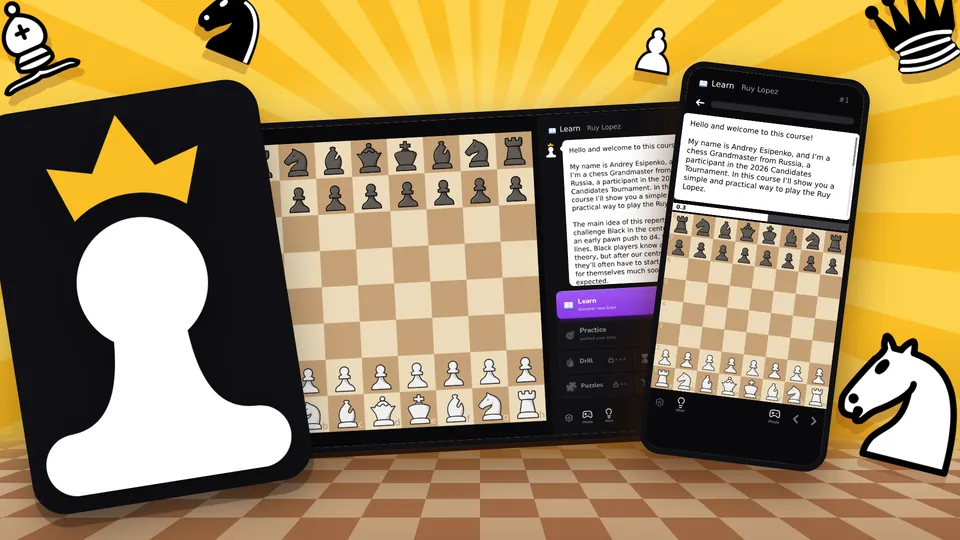
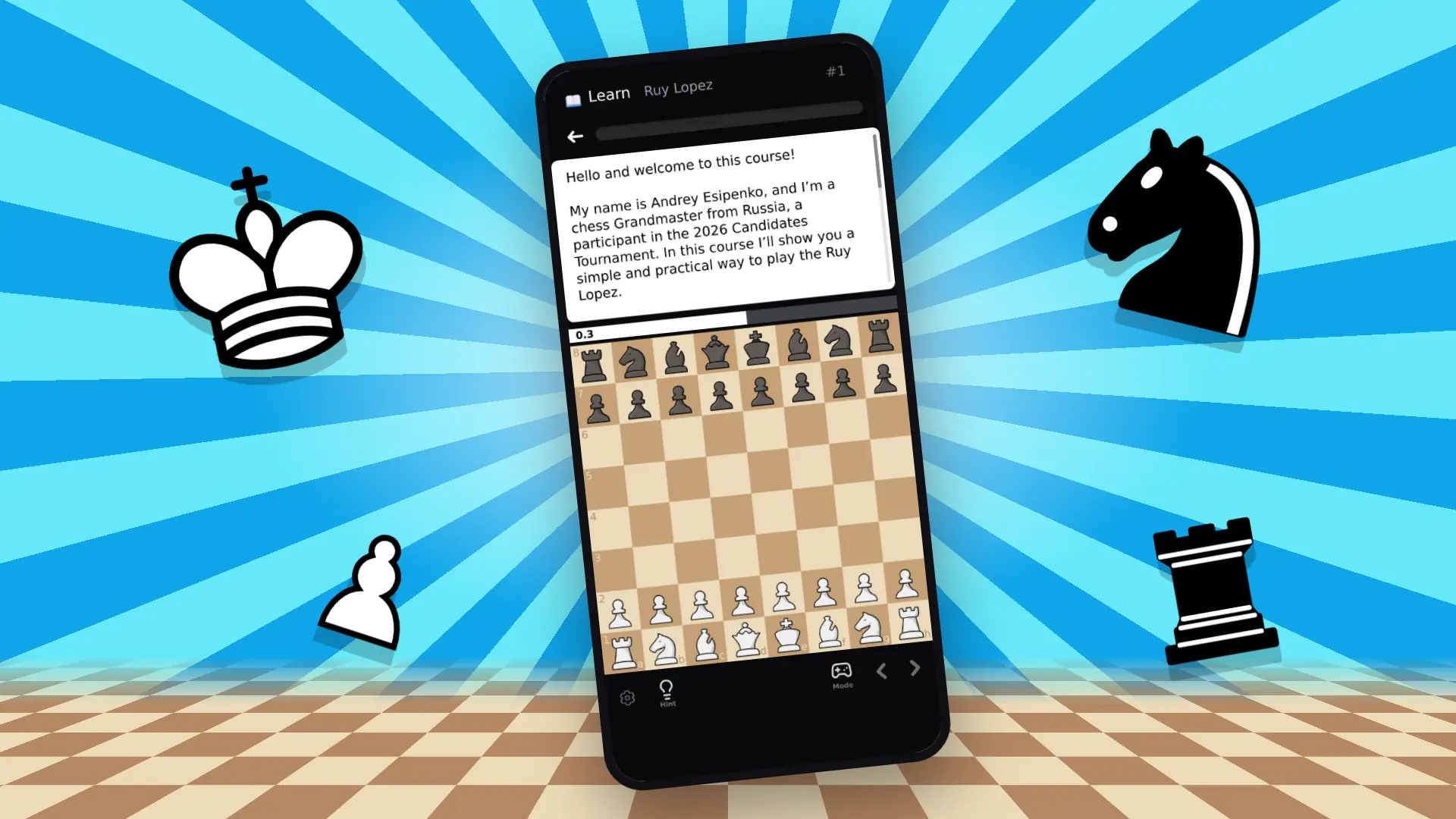
Open GM Andrey Esipenko's Ruy Lopez on Chessreps and you play 1.e4 yourself. The course answers 1…e5 the way an opponent would, you continue 2.Nf3, and by 3.Bb5 you're in the opening the course is about. The author's note appears when the position needs an idea explained. If you play a move the line doesn't include, Chessreps explains what's wrong with it and lets you take it back. The grandmasters writing these courses include Wei Yi, Andrey Esipenko, Boris Gelfand, and Mitrabha Guha.
Chess.com's MoveTrainer spaces reviews on a ladder of 8 levels, from 4 hours up to 6 months. Chessreps Practice schedules whole lines with FSRS spaced repetition, so every review is a short game from move one, the way you'll reach the position at the board.
How do you practice openings against an opponent?
Chess.com lets you practise a chosen opening against a bot, and Chessreps Arena plays your opening against moves real Lichess players chose near your rating.
On Chess.com, Practice → Openings asks you to pick an opening and a colour, then you play any line you like against a bot. It's a quick way to try a line out, and Chess.com says the full Practice feature is on the website rather than in the mobile apps.
Arena on Chessreps works from the moves people play. Each reply is drawn from Lichess games near your Arena rating, in proportion to how often players there chose it. When their moves run out, the engine judges the position and your rating goes up or down. Each course keeps its own Arena rating, starting at 950, so you can see which opening needs work. The full rules are on the Chessreps vs Chessable page.
The same lines also feed Drill, a streak that ends at your first mistake, Time Trials against a clock, and Puzzles taken from Lichess games where the opponent left your line and blundered. The modes are described in full there.
Do the courses cover the moves your opponents play?
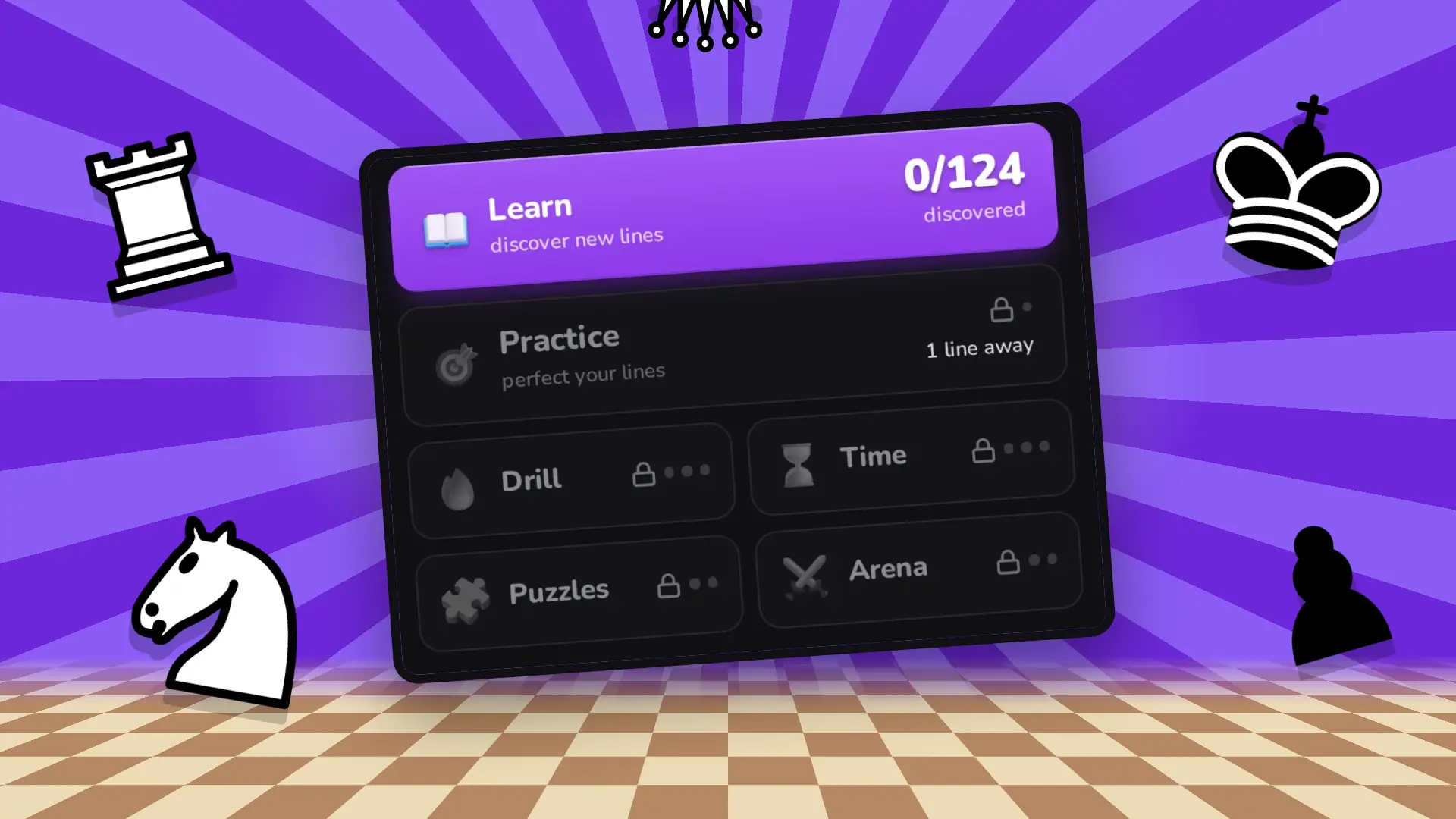
Every Chessreps course gets a coverage score against real Lichess games, and the titled authors answer the most common replies first.
We look at each position where it's the opponent's turn and count the replies Lichess players chose there. A common reply the course doesn't answer yet is a gap, and a gap weighs more the more often you'd reach it. Authors close the heaviest gap, then the next, until little is left that a real opponent is likely to play. The coverage score is explained in full on the Chessable page.
On Chess.com the Game Explorer shows how often a line comes up in its database. Free accounts see the first 4 moves.
Can you study Chess.com courses in the app?
No. Chess.com's help page says its courses can only be studied on the website, in a desktop or phone browser, while every Chessreps course works in the Chessreps app and on the web.
Chessreps runs on the web, iPhone, iPad and Android under one account, and your progress syncs between them. You can play the first line of any course before you make an account. Both apps are well liked in the US stores: Chessreps has 4.9 (2,400+ ratings) on the App Store and 4.9 (2,700+ reviews) on Google Play, and the Chess.com app has 4.8 (868K ratings) and 4.7 (3.48M reviews). Chess.com's ratings cover its whole app, not only its opening tools.
Is Chessreps cheaper than Chess.com?
Yes. Chessreps costs $34.99 a year on the web with every course included, and Chess.com Gold costs $49.99 a year on the web before you buy a course.
Chess.com's yearly web prices are $49.99 for Gold, $79.99 for Platinum and $119.99 for Diamond. Courses are sold separately. Diamond includes 300+ of them and takes 20% off the rest, and the courses you buy come with a 30-day money-back guarantee.
A year of Chessreps comes to about 70% of Gold, and Diamond costs more than three times as much as Chessreps. Both start with a 7-day free trial.
Can you build your own opening repertoire on either?
Yes, both let you put together a repertoire of your own, from different starting points.
The Chessreps course creator takes a PGN you paste or drop in, or a Lichess study, and turns it into a course you train in every mode. It checks your lines against Lichess games and lists the replies you'll face most that your repertoire doesn't answer yet.
Chess.com's Opening Repertoires feature combines lines from the courses you own into one custom course, and you can add lines of your own. It suits a player who already owns several Chess.com courses.
Where is Chess.com the better pick?
Pick Chess.com if you want one account for playing, lessons, game review and opening study, and you mostly study at a computer.
Chess.com's opening tools connect to the rest of the site. Course Check in Game Review shows where your real games left the course you own. The Openings page gives newer players a coach-led start on an opening. The explorer holds nearly 3 million master games, and the course shop has 1,415 titles. If you already pay for Diamond, 300+ courses come with it.
Which should you pick?
For learning openings, pick Chessreps, and keep Chess.com for playing.
If you want to play a new opening this week, study it on your phone and not buy a course for each one, Chessreps covers that with every course in one membership and Arena to test a line before you use it in a game. If Chess.com is already your home for games and you'd rather keep everything there, its courses and Course Check work well together. Nothing stops you using both, with your games on Chess.com and your openings on Chessreps.
How we compared
I've used Chessable, Chessly, Chessbook and Lichess myself. Every competitor fact on this page comes from that product's own website, help pages or store listing, read on November 3, 2026. Each source is listed below. Prices are in US dollars. Store ratings are from the US App Store and Google Play on the same day.
Prices and features change. If something here is wrong or out of date, email ethan@chessreps.com and I will fix it and update the date at the top.
Sources checked
- Chessreps
- Chess.com
- www.chess.com/membership
- support.chess.com/en/articles/8562418-what-does-each-level-of-premium-membership-get-me
- www.chess.com/courses/all
- support.chess.com/en/articles/10319322-how-does-the-spaced-repetition-scheduling-work
- www.chess.com/article/view/chesscom-update-april-2026
- apps.apple.com/us/app/chess-com-play-and-learn/id329218549
- play.google.com/store/apps/details?id=com.chess&hl=en_US&gl=US
- support.chess.com/en/articles/10319328-can-i-learn-my-courses-on-the-chess-com-mobile-app
- support.chess.com/en/articles/8615183-what-is-the-game-explorer
- www.chess.com/announcements/view/new-learn-openings-on-chess-com
- www.chess.com/news/view/announcing-game-review-course-check
- support.chess.com/en/articles/8724749-what-is-practice-on-chess-com
- www.chess.com/news/view/chesscom-acquires-pmg
Chessable, Chessly, Chessbook, Lichess and the other names and logos on this page belong to their owners. Chessreps isn't affiliated with them.
Frequently asked questions
Is Chess.com good for learning openings?
Chess.com has several opening tools: lessons, short coach-led courses on its Openings page, 1,415 MoveTrainer courses sold one by one, Practice against a bot and an explorer of nearly 3 million master games. Chessreps puts opening study in one place, a course you learn by playing it, with 59 titled players' courses included for $34.99 a year on the web.
Is learning openings on Chess.com free?
Partly. Chess.com's free Basic plan includes a daily lesson and a daily full Game Review, and its explorer shows the first 4 moves. Courses are sold separately. On Chessreps the first line of every course is free to play without signing up.
Can you study Chess.com courses in the app?
No. Chess.com says its courses can only be studied on the website, which you can open in a phone browser, and not in the iPhone or Android apps. Every Chessreps course works in the Chessreps app on iPhone, iPad and Android and on the web, with progress synced between them.
Is Chessreps cheaper than Chess.com?
Yes. Chessreps costs $34.99 a year on the web with every course included. Chess.com Gold costs $49.99 a year on the web, Platinum $79.99 and Diamond $119.99, and Chess.com courses are sold separately, with 300+ of them included in Diamond.
Does Chess.com own Chessable?
Yes. Chess.com acquired Play Magnus Group, which includes Chessable, in December 2022. Chess.com's Courses use Chessable's MoveTrainer.