Chessreps vs Chessbook in 2026: a course or build your own?
We make Chessreps. This page says where each tool is the better pick.
Short answer
Pick Chessreps if you want to start on a finished course today and learn it by playing it. There are 59 courses by 41 titled players, each checked against real Lichess games, with rated Arena games to test them, for $34.99 a year on the web.
Pick Chessbook if you want to build and maintain your own repertoire, choosing each move with Lichess data at your rating, Stockfish and Autofill to help.
By Ethan Netz, founder of Chessreps · Updated · Competitor facts checked
How do Chessreps and Chessbook compare?
Both use Lichess game data to decide what a repertoire must cover, and both schedule reviews with FSRS. The split is who makes the choices. On Chessreps a titled player has already made them, and on Chessbook you make them yourself with the software's help.
| Chessreps |  Chessbook | |
|---|---|---|
| Where the lines come from | ||
| Where the lines come from | 59 courses by 41 titled players and 800+ community courses. Every course gets a coverage score against real Lichess games. | You choose them, using Lichess data at your rating, Stockfish and Autofill. 23 free pre-made repertoires. |
| How it drills you | ||
| How it drills you | You play every move yourself and the course answers. FSRS spaced repetition in Practice, plus Drill, Puzzles, Time Trials and a rated Arena. Wrong moves are explained. | FSRS spaced repetition for each move, plus training games against a human-like bot. |
| Build your own or import | ||
| Build your own or import | Course creator: paste or drop a PGN, or import a Lichess study. It lists the gaps you will face most. | Yes. Import PGN, Lichess studies, or your Lichess and Chess.com games. Export to PGN. |
| Platforms | ||
| Platforms | Web, iPhone, iPad, Android | Web, iPhone, iPad, Android |
| Free option | ||
| Free option | No signup to start. The first line of every course is free. | Free forever plan that saves up to 200 moves. |
| Paid price | ||
| Paid price | $34.99/year on the web after a 7-day free trial. App store prices are higher because Apple and Google take a cut. | Pro is $7/month billed annually. iOS in-app: $7.99/month or $79.99/year. |
| App Store (US) | ||
| App Store (US) | 4.9 (2,400+ ratings) | 4.9 (2.2K ratings) |
| Google Play (US) | ||
| Google Play (US) | 4.9 (2,700+ reviews) | 4.8 (5.55K reviews) |
| Best for | ||
| Best for | Learning openings by playing them, from ready-made courses built around the moves real opponents play. | Building your own repertoire from scratch, guided by data at your rating. |
| Main trade-off | ||
| Main trade-off | Shorter courses than a long GM book, and no long video lectures. | A tool more than a teacher: few explanations, and many repertoire decisions are yours. |
A check marks the best value in each column.
What do Chessreps and Chessbook have in common?
Chessreps and Chessbook share more than most opening trainers do. Both build on Lichess game data and FSRS spaced repetition, both import a PGN or a Lichess study, and both run on the web, iPhone, iPad and Android.
Players rate them about the same, too. Chessreps has 4.9 (2,400+ ratings) on the App Store and 4.9 (2,700+ reviews) on Google Play, and Chessbook has 4.9 (2.2K ratings) and 4.8 (5.55K reviews).
I've used Chessable, Chessly, Chessbook and Lichess myself, and Chessbook is the one that feels least like a rival, because it answers a different question. Chessbook asks what you want to play and helps you build it well. Chessreps assumes you'd rather a titled player who knows the opening made those choices, and puts your time into learning them.
Do you start from a course or a blank repertoire?
On Chessbook you start from a blank repertoire, or from one of 23 free pre-made ones, and choose your own moves, while on Chessreps you start from a finished course.
Say you've just taken up the Caro-Kann and need an answer to everything White might try. On Chessbook you work through White's options yourself, looking at what players at your rating choose, checking Stockfish, and letting Autofill draft the branches you haven't decided without touching the moves you've saved. The pre-made repertoires, 14 for White and 9 for Black, give you something to edit if an empty board is daunting.
On Chessreps you open a Caro-Kann course and play its first line straight away, without signing up. A titled player has made the decisions and written a note wherever the position needs one, so the first evening goes into learning moves rather than choosing them.
You give up some control in exchange. A Chessreps course is its author's repertoire. Members can copy a course into the course creator and change their own version, but that's editing someone else's work, not building your own from the ground up.
How does each one use Lichess data?
Chessbook uses Lichess data at your rating to guide what you add while you build, and Chessreps uses it to check a finished course, which is then the same for every player.
Chessbook asks for a coverage goal of "1 in n games" and then asks you to prepare every position you can expect at least that often, using games from your rating range. It's a thoughtful design, and it means two players with the same opening can end up with different repertoires because they meet different opponents. A Chessreps course doesn't reweight itself for your rating. Instead, any common reply it leaves unanswered counts against its coverage score, and the authors close the biggest gaps first. The method is explained in full on the Chessreps vs Chessable page.
How much rating changes things depends on the line. In the Blackburne Shilling, 1.e4 e5 2.Nf3 Nc6 3.Bc4 Nd4 4.Nxe5 Qg5, White's greedy 5.Nxf7 runs into 5…Qxg2 6.Rf1 Qxe4+ 7.Be2 Nf3 mate. Among Lichess players rated 800 to 999 who reach the position after 4…Qg5, 48% take on f7. Among players rated 1800 to 1999 it's still 22%. Some traps fade quickly as ratings rise, and this one barely does, so both tools would tell a Black player who sets it to know the mate by heart. Every band is on our page of what players play at every rating.
How does each one drill you?
Chessbook schedules each move on its own with FSRS, and Chessreps uses FSRS to schedule whole lines that you replay from the first move.
Per-move scheduling spends your time only on the moves you forget. Per-line scheduling costs more time per review, but every review is a short game from move one, which is how you'll reach the position on a board. Chessbook has a second trick I like a lot. If you connect your Lichess or Chess.com account, correct repertoire moves in your real games count as reviews, and the moves where you left your repertoire get flagged.
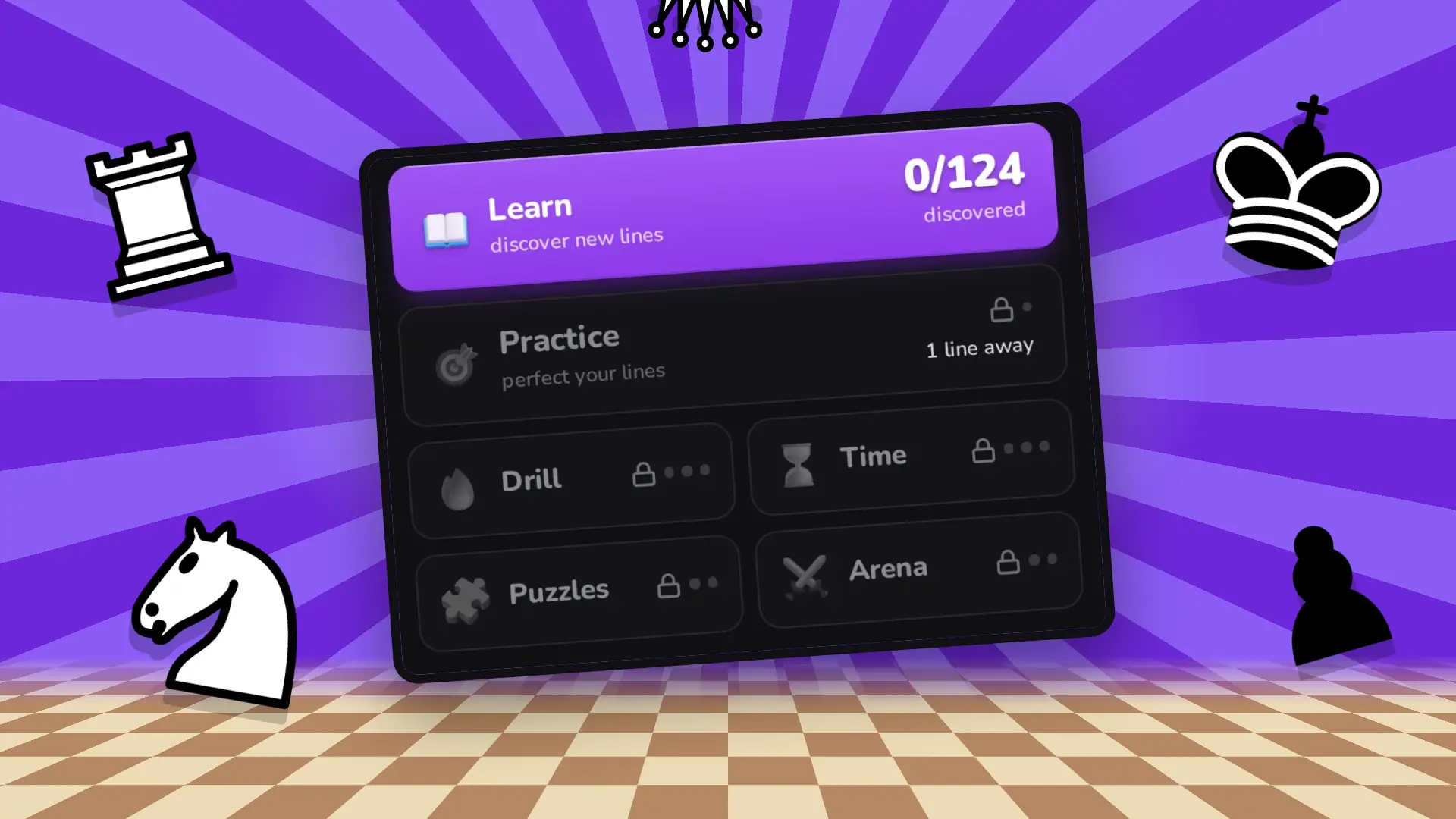
For playing an opening out, the two are closer than you might expect. Chessbook's training games put you against a bot that plays what people at the level you choose play. Chessreps Arena draws each reply from Lichess games near your Arena rating, and when the moves run out it scores the position with the engine and adjusts a rating that each course keeps for itself. Chessreps also turns the same lines into a streak, a timed race and puzzles, which the Chessreps vs Chessable page describes.
Which is cheaper, Chessreps or Chessbook?
Chessreps is cheaper on the web, at $34.99 a year against $84 for Chessbook Pro, which Chessbook bills as $7 a month paid annually.
That puts Chessreps at about 42% of Chessbook's web price. Both apps have their own in-app prices, listed in the table.
The free options suit different players. Chessbook's pricing page describes a free plan that never expires and saves up to 200 moves, which is enough to try the builder properly. Chessreps needs no signup, lets you play the first line of every course, and offers a 7-day free trial of the rest. If you pay for Chessbook and change your mind, it refunds within 14 days of your first subscription purchase.
Can you build your own repertoire on Chessreps?
Yes, the Chessreps course creator turns a PGN or a Lichess study into a course you can train, though Chessbook's builder does more.
Paste or drop in a PGN, or give it a Lichess study link, and the creator checks your lines against Lichess games and lists the common replies you haven't prepared, the most often reached first. You can build a private course and train it with an account and no membership, in the same modes as any course. It needs a computer or tablet, since the creator doesn't open on phones.
Chessbook goes further on every part of building, with Autofill, a goal tuned to your rating range, connected accounts and PGN export. If you already keep a repertoire there, export it as PGN and paste it into the Chessreps creator to see its gaps and drill it in Arena.
Where is Chessbook the better pick?
Chessbook is the better pick if every move in your repertoire should be your own choice, with software helping you make it.
Autofill fills gaps without overwriting what you saved. The coverage goal follows your rating range, your online games count as practice, and the training bot plays like people at your chosen level. The free plan never runs out, and PGN export means your work isn't tied to one app. A Chessreps course, by contrast, gives every player the same lines, and changing them means editing someone else's repertoire.
Which should you pick?
One question settles most of it, which is whether you want to decide every move yourself.
If you do, and you already know roughly what you play, Chessbook will serve you better, and connecting your online games makes it better still. If you'd rather a player who knows the opening decided, and you want to be playing it this week with notes that explain the ideas, Chessreps fits. A Chessbook repertoire can also go into the Chessreps creator as a PGN, so trying both costs little.
How we compared
I've used Chessable, Chessly, Chessbook and Lichess myself. Every competitor fact on this page comes from that product's own website, help pages or store listing, read on November 2, 2026. Each source is listed below. Prices are in US dollars. Store ratings are from the US App Store and Google Play on the same day.
Prices and features change. If something here is wrong or out of date, email ethan@chessreps.com and I will fix it and update the date at the top.
Sources checked
- Chessreps
- Chessbook
- www.chessbook.com/pricing
- wiki.chessbook.com/getting-started
- wiki.chessbook.com/spaced-repetition
- wiki.chessbook.com/import-export
- apps.apple.com/us/app/chessbook-master-openings/id6466343415
- play.google.com/store/apps/details?id=com.chessbook.android&hl=en_US&gl=US
- wiki.chessbook.com/completion
- wiki.chessbook.com/autofill
- wiki.chessbook.com/connected-accounts
- wiki.chessbook.com/training-games
- www.chessbook.com/courses
- www.chessbook.com/fulfillment_policy.html
Chessable, Chessly, Chessbook, Lichess and the other names and logos on this page belong to their owners. Chessreps isn't affiliated with them.
Frequently asked questions
Is Chessbook free?
Chessbook has a free plan that never expires and saves up to 200 moves, according to its pricing page. Pro costs $84 a year on the web.
Is Chessreps cheaper than Chessbook?
Yes, on the web Chessreps costs $34.99 a year and Chessbook Pro costs $84. In-app prices differ from web prices for both.
Is Chessbook good for beginners?
Chessbook gives beginners 23 free pre-made repertoires to start from, and after that most decisions about what to play are yours. If you'd rather have those decisions made and explained by a titled player, Chessreps starts you on a finished course, and you can play its first line without signing up.
Do Chessbook and Chessreps both use FSRS?
Yes, both schedule reviews with FSRS spaced repetition. Chessbook schedules each move on its own, and Chessreps schedules each line.
Can I move my Chessbook repertoire to Chessreps?
Yes, you can move a Chessbook repertoire to Chessreps as a PGN. Chessbook exports your repertoire to PGN, and the Chessreps course creator accepts a pasted or dropped PGN, then lists the common replies your repertoire doesn't answer yet.
Does Chessreps have Autofill?
No, Chessreps has no Autofill. A titled author, or you, chooses every move. Chessbook's Autofill drafts a repertoire to your coverage goal and never overwrites moves you saved, so if you want software to suggest your repertoire, that's a reason to pick Chessbook.