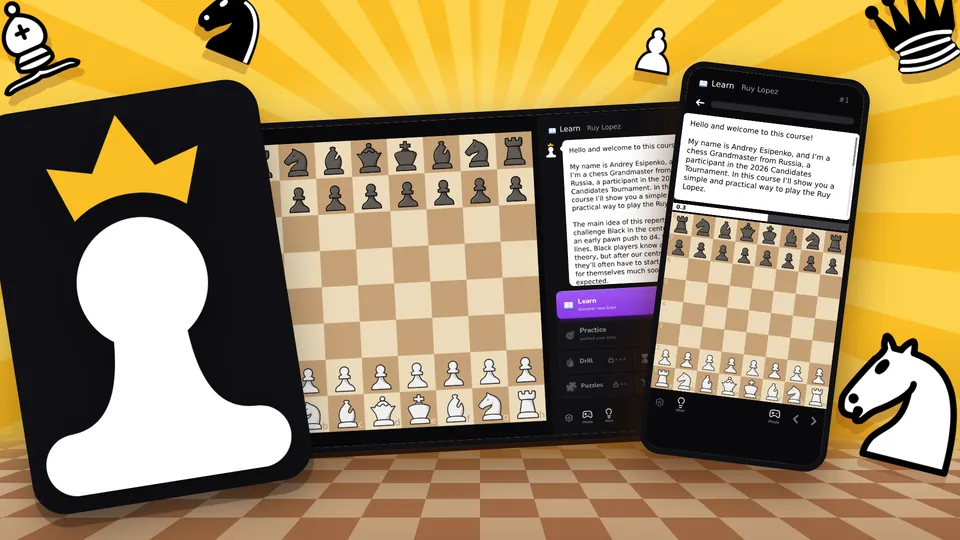
Which chess opening trainers are free to use in 2026?
We make Chessreps. This page says where each tool is the better pick.
Short answer
Lichess, Listudy and Chessdriller are completely free, and Chesstempo's opening trainer is free too. The usual free setup is to write your lines in a Lichess study and drill them with Listudy or Chessdriller. Chess.com, Chessbook and Chessable have free plans with limits.
Chessreps is free to start. You can play the first line of any course without signing up, then try every course in a 7-day free trial, and after that everything costs $34.99 a year on the web. It is rated 4.9 (2,400+ ratings) on the App Store and 4.9 (2,700+ reviews) on Google Play (US).
By Ethan Netz, founder of Chessreps · Updated · Competitor facts checked
What does each opening trainer give you for free?
Lichess, Listudy and Chessdriller give you everything, Chesstempo gives you its whole opening trainer, Chess.com, Chessbook and Chessable each give you part of the product, and Chessreps gives you the first line of each course. The table sets each free option next to how the tool drills you and what paying adds, as read on each product's pages on November 2, 2026.
| Tool | Free option | How it drills you | Where the lines come from | Platforms | Paid price |
|---|---|---|---|---|---|
 Lichess | Every feature is free for everybody. | No opening spaced repetition. An interactive lesson chapter walks you through a line, with hints and feedback on wrong moves. | You find or write them in user Studies. The opening explorer covers 6 billion games. | Web, iPhone, iPad, Android | Free. No ads, no subscriptions. |
| Listudy | Everything is free. | Spaced repetition. A mistake brings the position back sooner. | Your PGN, a Lichess study, or public user studies. | Web | Free and open source. |
| Chessdriller | Everything is free. | Spaced repetition from 10 minutes up to days. A wrong move resets the interval. | Your Lichess studies, after you log in with Lichess. | Web | Free and open source. |
 Chesstempo | Opening training is free. The explorer stops at 10 moves for free members. | Spaced repetition, limited to a branch, a repertoire or a colour if you like. | You supply them, by PGN import or by entering moves. | Web, iPhone, iPad, Android | Silver, Gold and Diamond tiers. US App Store monthly: $2.99, $3.99 and $8.99. |
 Chess.com | Basic: one lesson and one full Game Review a day. The explorer shows the first 4 moves. | MoveTrainer spaced repetition on 8 levels, 4 hours to 6 months, and Practice against a bot. | Lessons and MoveTrainer courses by members or masters, and a master explorer of nearly 3 million games. | Web, iPhone, iPad, Android | Gold, Platinum and Diamond tiers add the full explorer, unlimited lessons and unlimited Game Review. |
 Chessbook | Free forever plan that saves up to 200 moves. | FSRS spaced repetition for each move, plus training games against a human-like bot. | You choose them, using Lichess data at your rating, Stockfish and Autofill. 23 free pre-made repertoires. | Web, iPhone, iPad, Android | Pro is $7/month billed annually. iOS in-app: $7.99/month or $79.99/year. |
 Chessable | A free account with a selection of free courses and MoveTrainer. | MoveTrainer spaced repetition on a fixed 8-step ladder, 4 hours to 6 months. A miss sends the move back to the start. | Chosen by each course's author. 1,000+ courses by 400+ authors, many of them GMs. | Web, iPhone, iPad, Android | PRO is $11.99/month or $74.99/year. PRO does not include courses; most are bought one by one. |
| Chessreps | No signup to start. The first line of every course is free. | You play every move yourself and the course answers. FSRS spaced repetition in Practice, plus Drill, Puzzles, Time Trials and a rated Arena. Wrong moves are explained. | 59 courses by 41 titled players and 800+ community courses. Every course gets a coverage score against real Lichess games. | Web, iPhone, iPad, Android | $34.99/year on the web after a 7-day free trial. App store prices are higher because Apple and Google take a cut. |
A check marks the best value in each column.
Which tools cost nothing at all?
Lichess, Listudy and Chessdriller have no paid tier at all. Lichess is where you research and write your lines, and the other two drill them.
Lichess has no ads and no subscriptions, and every feature is free for everybody. For openings that means an explorer built from 6 billion games that you can filter by rating band, studies where you write and share lines, engine analysis, and real opponents. A study chapter can also be set up as an interactive lesson, which walks you through a line with hints and feedback on wrong moves. What Lichess doesn't have is spaced repetition for openings. Its Practice section covers checkmates, tactics and endgames, and nothing on the site brings a line back because you were about to forget it.
Listudy and Chessdriller fill that gap, and both are free and open source. Listudy takes a PGN file or a Lichess study and drills it in the browser, bringing a position back sooner when you miss it. Chessdriller works from your Lichess account. You log in, pick your studies, and it schedules reviews from 10 minutes up to days, resetting the interval when you miss a move.
Listudy's changelog stops on November 20, 2022. Chessdriller calls itself a beta, and its GitHub repository is archived. Your lines stay in a Lichess study or a PGN file either way, so you lose nothing if one of them stops working.
How do you learn an opening without paying anything?
You can learn an opening for free in five steps: pick it, check how it does at your rating, write it in a Lichess study, drill the study, and patch it after each game. The King's Gambit as White makes a good worked example, because how well it scores depends heavily on rating.
- Choose one opening per colour. As White, say 1.e4 with the King's Gambit, 2.f4. As Black you need an answer to 1.e4 and one to 1.d4. Starting small means you finish something.
- Check what happens at your level. In the Lichess explorer, set the rating band closest to yours, go to the position after 1.e4 e5 2.f4, and note how often Black takes the pawn and how often they decline. Then look at how the gambit scores. On our count of Lichess games, White scores 56.6% with the King's Gambit at 1200-1399, about 5 points above White's usual score in that band. At 2000-2199 it scores 48.1%, about 6 points below.
- Write your lines in a Lichess study. Give 2…exf4 its own chapter and each common way of declining another, up to 64 chapters per study. Add a comment wherever you'd forget the idea, such as why the king often walks to f1.
- Drill the study. Import it into Listudy, or log in to Chessdriller and select it. Ten minutes a day is plenty while the lines are new.
- Play, then patch. After each game, find the move where you left your study and add the reply you didn't have. Over a few weeks the study starts to match your real opponents.
Step 2 is tempting to skip, and the King's Gambit shows what that costs. A gambit that wins games for you at 1300 can quietly turn into a losing choice once your opponents are a few hundred points stronger, and only the numbers for your band will tell you when. The full tables, gambits included, are on what chess players actually play at every rating.
Researching and writing each opening takes a few evenings, and keeping the study current is up to you.
What do the free plans of paid opening apps include?
Chesstempo's free plan includes its whole opening trainer, while Chess.com, Chessbook and Chessable give you a limited slice and charge for the rest.
On Chesstempo, opening training costs nothing. You enter your repertoire by hand or import a PGN, and it drills you with spaced repetition that you can narrow to one branch, one repertoire or one colour. Only the explorer is capped for free members, at 10 moves. If you already know your lines and just need somewhere to drill them, this goes a long way.
Chess.com's free Basic plan gives you one lesson and one full Game Review a day, and its opening explorer stops after the first 4 moves. Gold, Platinum and Diamond add the full explorer and unlimited lessons and Game Review. Chess.com also has a Practice mode where you play any line of an opening against a bot, though its membership page doesn't say which plan includes it (as of November 2, 2026).
Chessbook's free plan saves up to 200 moves, according to its pricing page. That is enough to build one opening and see how Autofill and its FSRS reviews feel, and Pro adds unlimited moves. Chessbook also offers 23 free pre-made repertoires.
A free Chessable account includes a selection of free courses and the MoveTrainer drill. Most full courses are sold one by one. PRO, at $74.99 a year, lowers their price but doesn't include them.
Is Chessreps free?
Chessreps is free to start. You can play the first line of any course without signing up. Only that first line of each course is free, and we would rather tell you here than have you find out on the second line. One Google Play reviewer called it "a paid app pretending to be a free app", and from where that player stood, the complaint is fair.
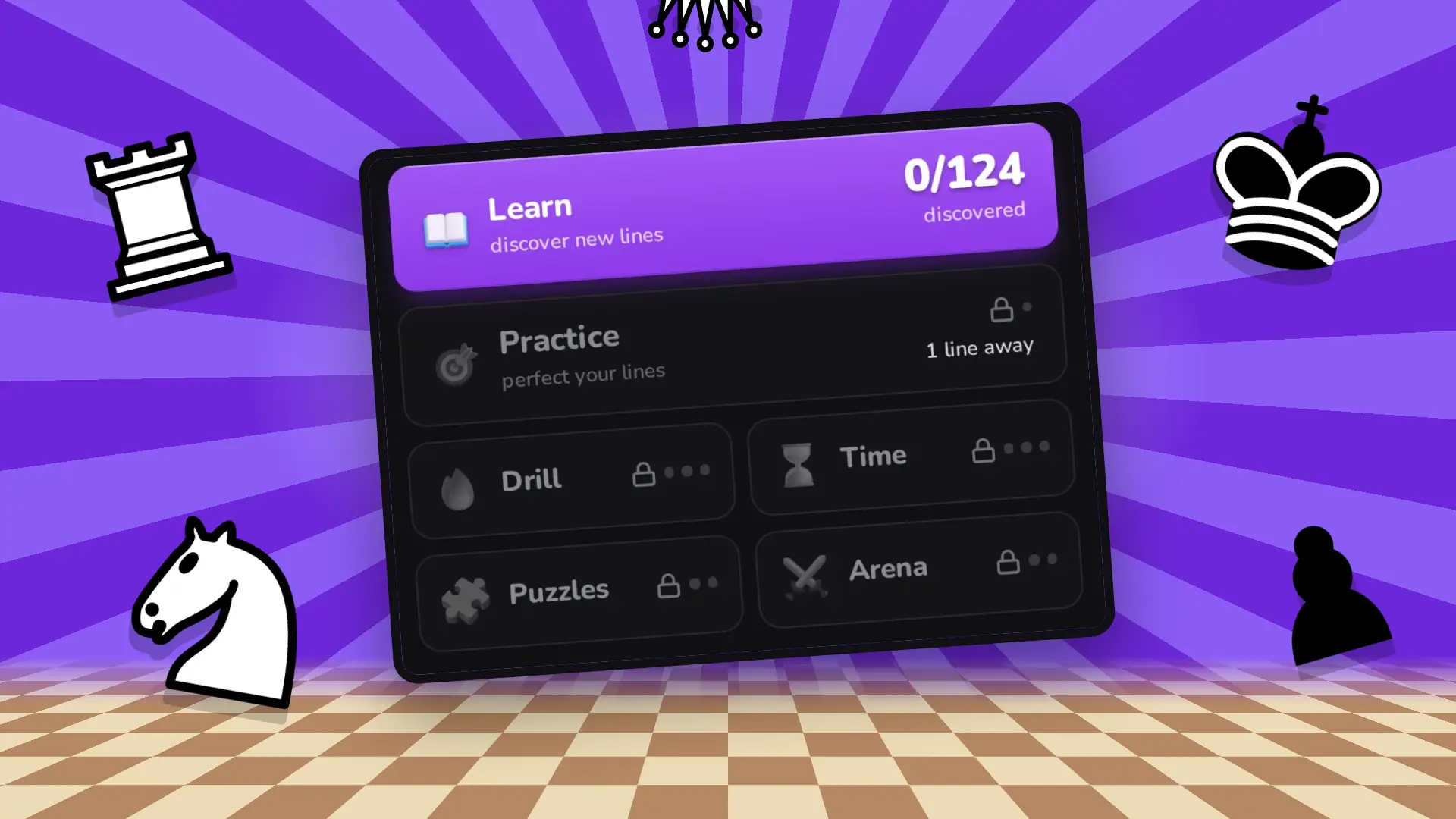
You can open any course and start playing at once, with no email and no account form. So you can play through the first line of GM Wei Yi's Italian, read his notes along the way, and see how a course plays. One free line is enough for that and to open Practice, and that's all. Drill, Time Trials, Puzzles and Arena want more lines learned, so you'll meet those during the trial.
The 7-day free trial opens every course and every mode. After that, everything costs $34.99 a year on the web. Prices inside the iPhone and Android apps are higher because Apple and Google take a cut. You can cancel yourself, in the app or on the web.
If you won't spend anything on chess, Chessreps is the wrong tool, and Lichess with Listudy or Chessdriller, or Chesstempo, will do the job.
When is Chessreps worth $34.99 a year?
Chessreps is worth paying for if you would rather spend your evenings drilling than researching and writing lines. The free routine above works, and what the membership buys is steps 2, 3 and 5 done before you arrive.
The courses come from 41 titled players, GMs Wei Yi, Andrey Esipenko, Boris Gelfand, and Mitrabha Guha among them, plus 800+ community courses. Each one carries a coverage score from checking its positions against real Lichess games, so the explorer work in step 2 has been done course by course. How the coverage score works is explained in full on our guide to every trainer.
Drilling also works differently from clicking through a study. You play your side of every line, the course answers, and a wrong move gets an explanation. Practice brings lines back on an FSRS schedule, and the other modes give you different ways through the same lines, including short rated Arena games against replies Lichess players chose at your level. The app runs on the web, iPhone, iPad and Android, has full offline support, and syncs your progress when you reconnect.
Against the other paid subscriptions, Chessreps costs less than half of Chessbook Pro ($84 a year) and Chessable PRO ($74.99). They sell different things, though. Chessbook Pro is a builder for your own lines, and PRO discounts courses you still buy one at a time. One player wrote, "I was surprised by the low price. Without flinching I would have easily paid double."
It isn't worth it if you already keep a repertoire you like in a Lichess study, because Chessdriller, Listudy or Chesstempo will drill it for nothing. It also fits poorly if you play only a handful of games a month, or if you want deep classical theory, where a long book from Chessable suits you better (see Chessable alternatives).
Which free option should you pick?
Start from where your lines already live, because each free tool reads a different source.
| Your lines are… | Use |
|---|---|
| in Lichess studies on your account | Chessdriller, which reads them after a Lichess login |
| in a PGN file, or a public study someone else wrote | Listudy |
| in your head, and you'd like tactics on the same site | Chesstempo |
| not chosen yet | The Lichess explorer and real games, to research first |
| not something you want to write at all | The first line of any Chessreps course, then the 7-day trial |
For paid trainers as well, see which chess opening trainer is best for you.
How we compared
I've used Chessable, Chessly, Chessbook and Lichess myself. Every competitor fact on this page comes from that product's own website, help pages or store listing, read on November 2, 2026. Each source is listed below. Prices are in US dollars. Store ratings are from the US App Store and Google Play on the same day.
Prices and features change. If something here is wrong or out of date, email ethan@chessreps.com and I will fix it and update the date at the top.
Sources checked
- Lichess
- lichess.org/patron
- lichess.org/features
- lichess.org/@/lichess/blog/interactive-lessons/WtDErSQA
- apps.apple.com/us/app/lichess/id1662361230
- play.google.com/store/apps/details?id=org.lichess.mobileV2&hl=en_US&gl=US
- github.com/lichess-org/lila/blob/master/modules/study/src/main/Study.scala
- lichess.org/practice
- github.com/lichess-org/api/blob/master/doc/specs/tags/openingexplorer/lichess.yaml
- Chesstempo
- Chess.com
- support.chess.com/en/articles/8562418-what-does-each-level-of-premium-membership-get-me
- support.chess.com/en/articles/8615183-what-is-the-game-explorer
- support.chess.com/en/articles/10319322-how-does-the-spaced-repetition-scheduling-work
- apps.apple.com/us/app/chess-com-play-and-learn/id329218549
- play.google.com/store/apps/details?id=com.chess
- support.chess.com/en/articles/8724749-what-is-practice-on-chess-com
- Chessbook
- www.chessbook.com/pricing
- wiki.chessbook.com/getting-started
- wiki.chessbook.com/spaced-repetition
- wiki.chessbook.com/import-export
- apps.apple.com/us/app/chessbook-master-openings/id6466343415
- play.google.com/store/apps/details?id=com.chessbook.android&hl=en_US&gl=US
- wiki.chessbook.com/completion
- wiki.chessbook.com/autofill
- wiki.chessbook.com/connected-accounts
- wiki.chessbook.com/training-games
- www.chessbook.com/courses
- www.chessbook.com/fulfillment_policy.html
- Chessable
- www.chessable.com/pro/
- support.chessable.com/en/articles/9016006-are-chessable-accounts-really-free
- www.chessable.com/
- support.chessable.com/en/articles/9043598-how-does-the-spaced-repetition-scheduling-work
- support.chessable.com/en/articles/14136733-what-is-the-opening-repertoire
- apps.apple.com/us/app/chessable-study-chess-smarter/id1523279049
- play.google.com/store/apps/details?id=com.chessable.chessable&hl=en_US&gl=US
- support.chessable.com/en/articles/9047946-why-is-the-number-of-games-on-import-limited
- www.chessable.com/blog/an-update-on-recent-changes-and-responses-to-your-questions/
- www.chessable.com/mt1/caruanas-ruy-lopez-dark-archangel/course/188495/?mt2lang=en
- www.chessable.com/mt1/aman-hambletons-london-system/course/353577/?mt2lang=en
- www.chessable.com/mt1/alex-banzeas-london-system/course/118788/?mt2lang=en
- www.chessable.com/mt1/counterblow-a-complete-fighting-repertoire-for-beginners/course/199358/?mt2lang=en
- support.chessable.com/en/articles/9034333-what-are-the-rating-ranges-of-your-recommendation-levels
- support.chessable.com/en/articles/9038743-i-constantly-have-too-many-moves-to-review-can-i-adjust-this
- support.chessable.com/en/articles/9043818-is-there-a-chessable-app
- support.chessable.com/en/articles/9028413-can-you-study-the-courses-offline
- www.chessable.com/blog/train-against-bots-the-highly-requested-feature-is-here/
- www.chessable.com/blog/4-chess-prep-things-you-can-now-do-smoother-and-faster-with-chessables-new-opening-explorer/
- support.chessable.com/en/articles/9039388-how-does-the-30-day-money-back-guarantee-work
- support.chessable.com/en/articles/9047959-can-i-export-my-course-as-pgn
- Chessreps
Chessable, Chessly, Chessbook, Lichess and the other names and logos on this page belong to their owners. Chessreps isn't affiliated with them.
Frequently asked questions
Can I learn chess openings for free?
Yes, you can learn chess openings for free with Lichess and a free drill tool. Lichess gives you the explorer and studies to write your lines in, and Listudy or Chessdriller drill those lines with spaced repetition. Chesstempo has a free opening trainer too. The cost is the time to find and write every line yourself.
Is there a free version of Chessable?
Chessable has a free account with a selection of free courses and the MoveTrainer drill, but most full courses are paid, and PRO doesn't include them.
Is the opening explorer free on Lichess, Chess.com and Chesstempo?
The Lichess opening explorer is free with no limits, while Chess.com and Chesstempo cap theirs for free members. Chess.com Basic shows the first 4 moves, and Chesstempo stops at 10.
Does Chessreps have a free trial?
Yes, Chessreps has a 7-day free trial. Before you start it, you can play the first line of every course without signing up. After the trial it is $34.99 a year on the web.
Is Listudy still maintained?
Listudy still works for drilling a PGN or a Lichess study, but its changelog stops on November 20, 2022. The site was up when we checked on November 2, 2026.
How many moves can I save on Chessbook for free?
Chessbook's pricing page says the free plan saves up to 200 moves, and Pro, at $84 a year on the web, adds unlimited moves. Its store listings give a different free allowance, so check the pricing page before you rely on the number.